Showing posts with label Children's Literature. Show all posts

Wednesday, May 25, 2022

Dustfinger's Lover

Cornelia Funke in the second installment of the Inkheart series offers a display of architectural writing that is so imperious that it borders on the villainous. 
Yet it would be too much to say that architectural writing is innately domineering, for this is as false as to say that all discovering writing is necessarily flaky and fitful. While these are the pitfalls of each style of writing, neither is always the case. 
What is necessary for both types of writing is a healthy dabbling in each style, a dalliance of architectural planning combined with the easy whimsy of discovery. Each needs a dose of the other for the story to feel coherent and complete.


At the end of Funke's Inkheart Fenoglio, the fabricated author of the fictional book Inkheart from which characters like Dustfinger are derived, is whisked into the fictional world he believes he has invented. 
Then in Inkspell we come across him in the Inkworld by which time he has become a well known poet known as the Inkweaver. He is still caught up in the belief that the world around him is a product of his own invention, and while this is in part true, it is nonetheless problematic.
Although Fengolio has by this time spent much time in his own world he still sees it as a place of his own making. Every time he encounters a new character he wonders whether this is one of those he had invented. Every time something doesn't go his way he kicks himself for making his world the way it is, as the problems which he viewed from the safety of the writer's chair are now his reality. Furthermore, every time one of his characters makes a choice of which he disapproves he rebukes them, bickering with himself that this is not what he created them for or that this is not what he would have had them do. 
In short, Fengolio is an author whose work has not only swallowed him up into its fictional realms, he is an author faced with the very real fact that his work has escaped his control, that his characters have minds of their own and choices independent of his authorial intentions for their destinies. 

What results is a writer who is constantly frustrated by his limited powers to keep his world under his control, a writer who meets beings of his own imagination and wonders why they are so unfamiliar, who is puzzled when he encounters things in his own world that he did not create. Yet even though his fictional world has become his real life he still feels the right to impose on it. His desire to tamper with the lives of his characters is nearly tyrannical as he crosses the limits of natural power to bring people back from the dead and later to kill, even writing real life people into his fictional world. 

Yet Fengolio is not portrayed as evil, only foolish. The image one is left with is one of an ignorant author sitting at a desk, the wildness of fiction outside his door, refusing to see that the wonders of his own creation have taken on a life of their own. Since the book was first written, characters have been born and died. Rulers have come and gone. Love has been abandoned and found. Characters have led lives and grown because of them. 
One cannot help but think that if Fengolio had laid back and simply discovered this world he would have found wonders beyond his wildest imaginings and a story more untamed and more real than he could ever have written.

The idea that characters keep on living after the author has put down his pen, that there are corners of fictional realms outside the author's maps, is pure fantasy.


There is a moment part way through the book in which Fengolio nearly has an epiphany. When he meets Dustfinger's lover for the first time he is so astounded by her beauty that cannot but put her beyond the credit of his own making. 

"All this is nonsense! What makes you think you invented her? She must always have been here, long before you wrote her story. A woman like this can't possibly be made of nothing but words!"
 
Fenoglio is of course right, and not just because that woman is literally standing before him as a being of flesh and bones with breath in her lungs and thoughts in her head that he did not put there. This fictional woman is also made up of all the things that words can conjure, whether that be wonder, love, hate, jealousy, longing, fear. No one can deny that fictional characters inspire real emotions in people.
So, while it is right to say that Dustfinger and his lover are made up of words, this could never explain why it is I as the reader care about them so much, why I hurt for Dustfinger when he suffers and why I am happy when he finally makes it home.
Perhaps he simply reminds me of someone I once knew, but if that is the case, it is someone I no longer remember, which means I know the fictional Dustfinger better than the real life person that makes him something familiar to me. 
Another explanation would be that he awakens feelings in me that I have felt before, feelings that make him fiercely relatable. After all, most every reader who spends time with Dustfinger will have known what it is like to miss someone, to be separated from the people that you love; they will have experienced homesickness in some shape or form. These types of longings are familiar, and this makes them real. 


This is perhaps what Fengolio fails to realize. The emotions and ideas behind these characters might have stemmed from his mind once. But there is something beautiful and dangerous that comes about when fictional characters are given real human desires, hearts that can yearn and hurt and resist. It awakens something real in these beings made up of someone else's words because they awake something in their readers who root for them and connect with them, who hope for their success and pity them for their failures.
The problem is that Fengolio hasn't changed. He has refused to grow as a writer, even though he recognizes that his love of unhappy endings is hurting fictional people made real, and even though he sees that his favourite characters are burdened by his own desires to keep them unhappy. Furthermore, he refuses to see that his characters have grown since he last knew them, that the story has gone on without him and thus doesn't really need him to continue. 
He wants to be an architect, wants to use his words to construct fictions entirely under his finger, keeping the unruly and unforeseen bits neatly out of his story.

There is nothing inherently wrong with the architectural writer and their careful ways, so long as they leave room for the unexpected, for a story's ability to grow of its own accord and evade the expectations of writers and their rules. After all, readers don't read for rules. They do not read because they wish story's to fulfill their expectations. They read to be pleasantly surprised by them, and because stories give them things to ponder which were not there before.


Fengolio doesn't want to see that, if a story can go one telling itself after the author is finished with it, it could certainly have begun before the author first took interest in it, in which case he hasn't made any of it up after all. He simply discovered it and gave it the possibility to be put into words.
The fact that Fengolio realizes this briefly when he looks at a wildly beautiful woman and then quickly forgets it shows that he still not really grown as a writer. His attitude towards his own story and his role in it hasn't grown. Yet something still changes for Fengolio after he meets Dustfinger's lover. 
 
His relentless desire to take control of his story subsides. His struggle to hold the power in his pen ends and so, when he writes the story's ending for Meggie to read aloud, he decides to write the ending that the story needs, not the ending he himself desires, unconsciously showing for the first time that some stories outgrow their writer's, that a story might know things the writer never did, and give thoughts to readers the writer himself never had. 
 
Whether one creates stories or discovers them, every writer, be they a builder or a wanderer, must eventually let go of their work and stand in its shadow to marvel at how much bigger it is than they ever hoped it could be, how many unforeseen paths there are still to wander, or how much sprung up in the background while they were busy laying their bricks.


Wednesday, January 26, 2022

A New Friendship

The image of Lucy and Mr. Tumnus walking through the snow was Narnia's beginning, and so it is rightfully its most famous illustration. 
It depicts the start of a wonderful friendship. But this discovery marks more than just the first meeting of two friends. It was also the onset of the Pevensie's adventures in Narnia, just as it marks the start for all those countless readers who have fallen in love with Narnia since. 
 
 
For Professor Lewis, Narnia began with a glimpse of a faun carrying parcels through the snow. Though he himself did not know what it meant or where the faun was going until Lucy came across him. Everything else, great and small and wonderful, came after that walk in the snow. In this way, one might say Narnia began with the meeting of a girl and a faun in a wintry forest. In the story of stories and how they come to be, Narnia begins with friendship, and to me, nothing could be better.


"And so Lucy found herself walking through the wood arm in arm with this strange creature as if they had known one another all their lives" 

~ C.S. Lewis, The Lion, the Witch, and the Wardrobe 


Sunday, May 30, 2021

Half-Adult

The Ocean at the End of the Lane

On the day I started rereading The Ocean at the End of the Lane something stung me beneath my right eye.

I didn't notice the stinging itself, but I did notice that my eye was itchy and puffy afterwards, and, going to look into the mirror, I saw that it was red and swollen. 
 
I was disturbed by the reflection looking back at me if only because it offered a glimpse of what my face might look like if I were old. It was as if I had suddenly become half aged. The skin beneath my one eye grew heavy and red, folding over itself like swelling wrinkles. 

I shuddered, for I knew that it was in a similar fashion that the fiend that calls itself Ursula Monkton enters the story, burrowing its way into the protagonist's foot in the form of a grey worm. The ancient and strangely powerful Hemstock's refer to its kind as a flea. I thought it a fitting picture and I in turn wondered what it was that had bitten me. 


The Ocean at the End of the Lane is an amalgam of a book; only half aged; one half adult, the other a child. Indeed, it defies every attempt to force it into an age. Neil Gaiman, the book's own author, is still not certain whether it is a book for adults or for children. 
The book's child protagonist, a boy of 7, certainly makes it seem a book for young people. At first glance, at least. But, as Gaiman himself put it, if it were to be a book for children he might have had to remove the scene in which the boy's father, in a fit of unexplained madness, tries to drown him in the bath.  
 
The Ocean at the End of the Lane is questionable, to say the least. It is the only dark book featuring a young protagonist I have ever felt necessary to withhold from too a young a reader. Sometimes it is inappropriate; and yet, I think it is best to read it as if you were still a child. Indeed, someone too adult might try too hard to understand it. This would be a mistake, for in doing so it is likely that they will not understand it at all.

I have written before about the adult horrors in books meant for children. They are, as I point out in my post titled The Adult Shadows in the The Sisters Grimm, made more horrific because they are placed in contrast to a child's world inside a child's book, and so, they become all the more terrible because they are not supposed to be understood in the least. 
They are rendered the stuff of horror not because the adult world is necessarily horrifying, but because there is something frightful in it when seen from the perspective of a child.
 
But this is, of course, not only true in fiction. Few of us like to think about it, but the adult world once seemed just as alien and arcane to us as the dark powers inside this book do to me now.


There are moment's throughout every child's life when they realize, with a thought that feels a lot like a shudder, how little control they have over their own world. I grew up in a safe home, and my parent's tried to shelter me from the outside world like any loving parents do, giving the hard truths to me slowly and in good time at the appropriate age. They kept a close eye on the movies I watched and sometimes on the books I read, telling me just enough so that I would know what types of things to stay far away from.

Still, sometimes it scared me to know how little I knew; that life crippling mistakes could be made completely by accident, by the ignorance of trusting a stranger too well, or in messing with something dark disguised as just risky enough to be exciting. 

There remains ever on the edge of the child's life the possibility that things could fall out of control, and they, being small and mostly helpless, could do nothing about it. The idea that a child could somehow ruin their own life by not being adult enough, not knowing enough, or simply not knowing any better, makes me gulp. 


There were earlier glimpses in my own childhood before the time my parent's took a book I was reading away, telling me there were devilish themes inside of it. 
 
I was taught to be paranoid of strangers from a young age. I still have bad dreams about being taken by an unknown person sometimes, and although these dreams are nightmarish, they still do not compare with the real shuddering fear I felt when I was young and unable to judge what was dangerous and what not; such as the time an old man pulled over to talk to me when I was playing in my driveway, and I, forgetting everything I had been taught about being wary of strangers in a moment, stepped closer only to hear my dad shout my name in an alarming tone. 
 
I felt foolish afterwards and insecure, and even though he turned out to be a kind man (my dad spoke to him after I had left) I knew afterwards that there were risks out there I had no idea about. It was scary thinking that the things I read and the people I talked to could turn on me or do me ill. Worse still was the thought that I could not see it coming and so would be helpless in preventing it from happening.
 
The Ocean at the End of the Lane is, as I've said, half-adult. This is represented to me in the way the cover has folded over, as if someone (probably my little brother who borrowed it once and returned it in this condition) has only half looked at it, not daring to open the book all the way.
It is, after all, a book that is only ever half read; whether through the eyes of a child who does not recognize some of the adult things going on behind the windows, or an adult recalling what it felt like to be a child and have no control when their world changes, the book is designed not to be understood, or rather, to be only half understood. 

So, when the boy's father tries to drown him in the bath, we have no idea why. We know that he is not a violent man. Indeed, the story makes a point of telling us the boy's father has never once hit him. Still, any one that has ever had a short-tempered parent knows how scary it is to stand in their shadow, even if they do not touch you or hurt you, the angry look in their eye is enough to cause some level of fear. Thus, we do not need to understand why the father is harming the boy. Indeed, that is what makes it feel so scary and so very real. No child ever really knows why they are being harmed or why their parent and guardian has suddenly turned on them.
 
Having been a child once, everyone should know the fear of not being understood and of not understanding. With our limited language and perception, how can we explain when a teacher was cruel to us? When we do not really know what happened, much less how to explain; all we can really know is that something felt wrong about it. It is almost as if it is too adult for a child to talk about. They can not explain why an adult does what they do, neither can they always know exactly what was wrong about it. Children, while having a great sense for wrongness and injustice, are less than inept at explaining how they feel and why.
Furthermore, how can a child  know that, when an old man pulls over to talk to them that he might have ill intentions? How can a child even imagine what he might really be thinking? 

In The Ocean at the End of the Lane Ursula Monkton knows this, and she exploits this, turning the boy's parent's against him, making up lies about him, telling him that he will not be believed because he is a child and she is an adult. 
 
We do not know what Ursula Monkton really is, but she appears in the form of a grown-up, and the book makes this something truly horrible, telling us that "she was power incarnate.. She was the storm... she was the adult world with all its powers and all its secrets and all its foolish casual cruelty.


By the end of the story, the boy, now himself grown, has forgotten about the horrible events of his childhood. He does not remember Ursula Monkton. He no longer knows that his father once tried to drown him. 
This is necessary. It is necessary because, if we, like him, remembered for a second what it was like not to understand a world of change and unseen danger and out of control strangers, well, then we'd realize for ourselves what Lettie Hemstock, the eternal eleven year old of this story, said so well 

"The truth is, there aren't any grown-ups. Not one, in the whole wide world." 
 
If we remembered what it was like to be so and to know oneself to be so we'd realize with horror that not much has changed now that we are older. The truth is, we are all just children who aren't young anymore, and so we are half. Half-child, half-adult, only ever half understanding, only ever half-understood; and, being so, there is still and ever the lingering possibility that our world could cut loose from our control.
 
In which case this hybrid of a book, itself something compound and cross-stitched, can only be for us half-beings. 


Sunday, April 25, 2021

Lemony Snicket Risked His Life So We Could Read

A few weeks ago I read Lemony Snicket's Unauthorized Autobiography. I read it from the safety of my home, and other than announcing it on my goodreads account, no one knew I was reading it. Till now. 
 
Those of you familiar with the book will know that he urges you to read it in secret. "The book you are holding in your hands is extremely dangerous," he warns. "If the wrong people see you with this objectionable autobiography, the results could be disastrous." Lemony Snicket dedicated his life to the Baudelaire Case; and, although fate has not been kind to him, anyone at all invested to his work knows that it was far less kind to Mr. Snicket's brother and sister, Kit and Jacques. 
 
I do not believe this to be a case of luck, for there is almost as little of that in the life of Mr. Snicket as there is in the unfortunate lives of the Baudelaire siblings. Indeed, good fortune has nothing at all to do with it. For if Mr. Snicket is one thing, it's sneaky. 
 
He is evasive like no other, but never so much so as when standing in front of a camera, then he is slick as a shadow.  
 
To demonstrate I thought I would share a story here, a story which, I believe, will show just how sneaky and dedicated Mr. Snicket can be. 
 
 
It was well known among my colleagues that I never missed the annual used book sale event that took place in the town nearest the one where I once lived. 
Anyone that had spotted me there would also have known that I am a very thorough browser, owed in part to the help of my brothers, who are fellow readers and used book sale buyers. 
 
The strange occurrence that took place at this book sale in the year of interest was made all the stranger due to the fact that I had just been reading The Series of Unfortunate Events a few weeks prior. 
 
I do not know how Mr. Snicket knew this. But he must have heard of my own dedication to the case, not to mention my frustration at the lack of answers at the end of the 13th book, fittingly titled The End. You can imagine how pleased I was when I heard rumors that this was not really the end of the story. Other works existed, though they were rare and thus extremely hard to find.  
 
By this point I had given up all hope that I would ever learn more of the shadow of a man that lies behind the series. Even so, the dedications at the beginning of each of the novels still haunted me. They were, for me, the most heartbreaking and arresting part of the series as book by book a piece of the tragic story of Lemony Snicket's past was cast onto the grey page with poetic parlance. 
 
I desperately wanted to know more.
 
I believe it was my brother who came to me, holding up a book depicting three children on the back of a spotted horse, two girls and one boy. The sun itself smiled down at them, and the boy, a bespectacled, cheering looking lad, somehow managed to balance a frosted cake on his hand mid gallop. The book was titled something along the lines of The Luckiest Kids in the World!.
He might not have shown it to me at all, for it certainly was a trite little title, were it not for one interest aspect. I believe he put it something like this: 
 
"Look at this! Isn't this a rip-off of A Series of Unfortunate Events!" 
 
 
I told him to toss it in his bag with little more than a second thought other than that I would inspect it closer later. This book sale was so good, after all, the book was basically free.
 
You can imagine my surprise when later that same day the dust jacket was flipped and a new cover was revealed. 
I believe it was the familiar signature that gave it away in the end, for all one had to do was flip the book open and the letters LS were revealed.  
 
 
To this day I wonder what lengths Mr. Snicket had to go through to sneak the book into the sale. When I remember that day at the book sale now I see his shadow everywhere: the grey suit, the hat, his back always turned. How can I ever know for certain whether he was there? 
 
You might think me delusional. Perhaps you think I've made all this up.
Yet that is perhaps the strangest part. It's all true. Just ask my brother. 
 
It's all very perplexing, a word which here means something complicated or unaccountable, causing one to feel completely baffled, which, I believe, is just another word to describe the eternally sharp and ever sneaky Lemony Snicket. 
 
 
What ever else can be said about the occurrence, every well read child eventually learns that Lemony Snicket is a pen name, and thus only a character in the creation that bares his name. Evidently there's no way he could really have been there that day at the sale. Of course he didn't risk his life to share the story of the Baudelaire's with the public, much less did he in his fictional limits manage to smuggle his Unauthorized Autobiography into a used book sale for my brother to find.
 
It's simply more thrilling to imagine it that way. And so, no matter how often the World's Luckiest Children grin at me from that tacky cover, I know despite the irony of it all that luck had nothing at all to do with it.


Sunday, March 21, 2021

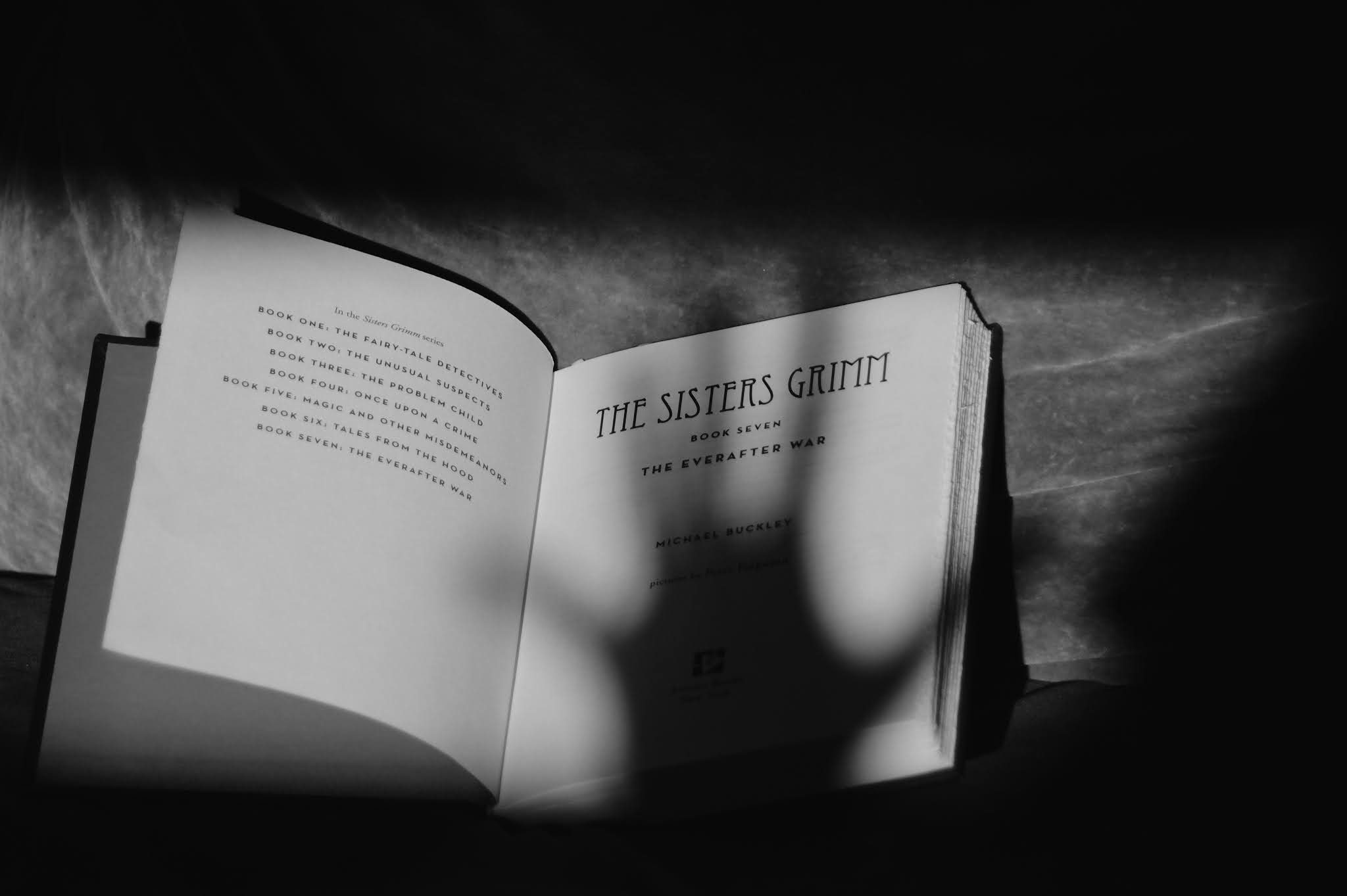
The Adult Shadows in "The Sisters Grimm"

The Sisters Grimm is a series I devoured as a child. The dark world inside this nine book installment utterly engrossed me. Indeed, if a child was ever addicted to a series of books, I was hooked by the nose to this one. 
I remember spending late nights reading them, flipping pages in the otherwise silent house, blinking through tired eyes. Each time I'd get to the end the words to be continued would stare at me, blurry and inconclusive, leaving me hungry for more. 

Never before had I found a series that ended with such twists: with dark faces staring at one from the dark, leaving one at the climax with the epitome of a horrible betrayal, enough to make one's heart twist up inside. Sometimes strange monsters lured one into secret places, offering secrets of the plot. The desire to follow them into the next chapter and so the next book would be maddening.


But, everything is better when you are a child, after all, and so, for a long time, I was hesitant to return to this grim world I once so devoured, fearful that my adult mind would find too many faults within its pages. 

As an adult, it is often hard to be anything more than charmed by the emotions of a protagonist meant to appeal mainly to children.
I was afraid that meeting some of my favorite fictional characters in this adult form of mine would disillusion me. They would become shallow versions of themselves. I would see through their sorrow, neglect to fear or be disturbed by their ugly and heinous ways, and find the once glorious humour bland and childish.   

Little did I know that The Sisters Grimm is an adult's tale full of the vengeful, the cruel, the broken, the abused, and the murderous. The most colourful characters are the children. Puck alone can stand for this. But the most interesting personalities were undoubtedly the adults. There was Mr. Canis with his dark inner demon; Uncle Jake with his own personal addictions and grievances. Even Prince Charming, a character that is usually two dimensional, often utterely annoying, was complex and deeply complicated. 

This, of course, is all obscured by its imaginative story, fully stuffed with fairy tale characters, all beloved and hated in their own way. Still, hidden under its child protagonist's noses are themes of grief, addiction, anger, and intense mental illness, all seen by their innocent eyes, the depth of them always misunderstood, left in the shadows. 

 
The first character we meet that struggles with a dark secret is Mr. Canis, an old man with a monster living in his head. Throughout the series, we watch Mr. Canis suffer under this perpetrators strains as slowly the old man loses himself to the monster inside of him, the Big Bad Wolf. 
Eventually, Mr. Canis is cruelly locked up for his questionable criminality. Yet, while we know that Mr. Canis is not evil, we also know that he is a danger, and so, the issue is, to say the least, complicated. Sabrina, the stories protagonist, is kept up at night worrying about the possibility of what might happen should the Wolf be set free, knowing full well that, according to the popular fairy tale, the has Wolf has eaten someone's grandmother before.
In Mr. Canis' his big watery eyes we see a man in pain. But in the man's shadow the children catch glimpses of a corrupt past that even the love and support of the Grimm's cannot mend.
 
It is often in their descriptions that the narrator cues us into the fact that there is more going on than meets the eye. I remember vividly the way the narrator describes Mr. Canis to the reader: his constant weariness; his frail, weak form and his thin grey skin. More often than not, he retreats to his rooms under presumptions of a headache or a bad nights sleep. Of course, this is not what is really going on.
Yet, while other stories would cast this man into a vile role, perhaps the evil villain's main monstrosity or a cruel schoolmaster with a hidden mental illness, in The Sisters Grimm this is the face of the Grimm Sisters sole protector, a man with a dark past and deep bedded flaws, but a man who would give anything of himself to protect them. 


Throughout the tale, we see many characters turn to the Scarlet Hand, an evil conspiracy the master of which, for much of the series, remains a mystery. Yet few (if any) of these characters become a part of the conspiracy because they are simply evil. Often, it is much more complicated than that. Time and time again, this series breaks these traditional stories apart, splitting them open with sharp realities, taking fairy tale villains and redeeming them just as it uses once good characters for evil. 
 
So, it is not the story itself that is complicated, but the people.
Evil stepmothers, power greedy princes, even monstrous beings are, in the end, just people in pain. 

When we finally do learn who the master of the Scarlet Hand is it is not the shock that lingers.
I remember the surprise of it all, but in retrospect, I also realized the clues had been there all along. In the end, what made it so effective wasn't just the fact that I, and others who read the series along side me, didn't see it coming, but that we didn't even consider it. Not only did we totally miss the signs, we neglected even to recognize the character as capable of such deep driven pain, and so, the distraught core of their being is the real shock; that, and the total neglect and disregard to the character's suffering which no one, not even the reader, had seen. 

Thus, the twist and betrayal of the master's big reveal didn't sting nearly as hard the fact that I, the reader, had never thought that enough hurt could drive anyone, even the most beloved characters, to such evil intent. The real horrible truth is that we cannot really blame them. When the evil master tells their story, we cannot deny that they are right: we really didn't see their hurt. 

Ultimately, it is a revelation to break your heart. 
 
 
I cannot think of any other children's story in which love interests are killed off and beloved side characters left to grieve them. I cannot think of any children's story in which, looking back, I see drunkenness in the eyes of a man once full of spirit; no where else do I look back and recognize between the lines of the narrative the mark of bitterness in the frail face of an old man who made too many mistakes in his youth.

I do not know of another tale where abused children are disguised as psychopathic villains only to be eventually redeemed and restored to childishness; or where close friends, often enough neglected, eventually turn on you; where good people sometimes do evil for fear of losing those they love. 

I implore you, parents, do not hide books like these away from your children. It would be foolish to think that they do not pick up on these things in the real world, that they do not see snippets of these adult shadows already. Since you cannot hide away the bad realities, please, do not try to refuse them their fictional echoes.
Let them see some snippet-trauma and some fragmented-grief in books like these. It is easier to digest when there is also some magic and wonder in it. 
 
Perhaps some day when they are older, they will return to books like these in their adult form and realize that they let them understand the world a little better: that seeing these things incorporated into a story woven out of fairy tales took away some of the shock of it later. Please, let us give it to them softly. 
Most importantly, let them see that bad people are also hurt people; let them see that wounded children don't always look like weak hurt things. More often, they look like bullies themselves.
 
The world would be a far better place if more people, children and adult alike, realized that there is always more to people than meets the eye. There is always more hurt in the shadows, and people do terrible things when they are not seen. In this real world, there is nothing worse than unseen suffering.
 
Sometimes the best thing you can do for someone is see them. I can truthfully say, The Sisters Grimm helped me learn how.


Sunday, February 7, 2021

Two Cups of Tea and One Book

What strange and mysterious things ensue, I do not know. But I found that one cup of tea quickly led to two as I read this afternoon.
 
Meanwhile, the day changed its course countless times, drizzling onto my window just to let the sun slip out for a while not long after. Then, later that evening, it started to snow sparsely. 

The day sure was eventful, and I found, though I am a quite a few chapters in, I still don't know what to think of it. 
 
As one test led to another, and I watched quietly while each of the three very resourceful children passed each obstacle differently, brilliantly, strangely.  
 
I half expect Lemony Snicket to come slinking out from some corner where he has been silently watching and admit, as if to make a point, that not even he knows what is going on and what all this could mean. 


The book begins like most of this nature do, with something strange stemming from some adult thing, like business trips, or moves to new homes due to financial struggle. More often than not, it is an uncertainty in an issue of child custody. This one begins with something even more adult and mundane, an ad in the paper with these inquiring words: "Are you a gifted child looking for special opportunities?"

The words are also printed on the back cover in red letters. 

One should note two things about this statement: first, it is addressed directly to a child, not the child's parents; and second, it slips in the words gifted, and special, which every child wishes to be.
 
 
These words are less strange on the back of a book than they would be printed in the paper. 
But I imagine any child (or adult) would be reading this book for the same reason they would note the ad in the paper with keen interest.
 
I am, of course, not a child. But I was unfairly not allowed enough time to be one, and so, I often like to read as if I still am one.  
The world is far more mysterious and whimsical when you are young and unfamiliar with issues of custody or financial struggles. A child is less likely to question the premise of a book, no matter how mysterious, just so long as it intrigues them or allows them the chance to be gifted and special, which admittedly, not only children wish to be.  
 
Perhaps by the third cup of tea the part of me that still reads in the voice of Lemony Snicket (or rather, Jude Law) will have a better sense of what is going on.

Sunday, January 10, 2021

The Grisly Giants Beneath the Earth

I recently read Roald Dahl's The BFG.  I was surprised by how lighthearted the tale was in comparison to other popular Dahl works.
The giants, though flesh eating and barbarically hideous, were not really enough to offer much fright to my imagination. Not even the more childish bits of my mind were spooked by the idea. The image of large hands groping in through my bedroom window and stuffing me head first into a large gaping mouth was not enough to writhe the dark parts of my fancy. 
 
I lay in bed the night I first began reading the book and I watched the branches of the tree outside my window as they bobbed closer and further, closer and further, and I thought to myself that, in the dark, it looked very much like a grapnel hand groping in the night, waiting for me to look away so it could break its mundane pattern and reach out to grab me.
 
I thought the hand was friendly enough though, and, if I'd have to imagine the giant at the other end of it, I'd say it was more than likely the fingers of the Big Friendly Giant I was looking at. 
The snow rested on its knuckles and wrists as if it had been standing there a good long while, waving at me to notice it so it would have no choice but to take me away and be my friend. 
It made the hand look old, pale, and wrinkled, and somehow lonely. 
 
It was enough to tickle my fancy, I admit, but I slept fine that night. I did not dream of giants and large hungry hands. I had no nightmares about a short lived life ended with one final speculation as one slides helplessly down a giant's dark throat. 

But then Roald Dahl did something else, something strange and I dare say frightening. He stuffed the giants beneath the earth, not as a tool of horror, but as a way to get rid of them. 

Now that, I thought, that was a way to scare me, to put my imagination out in the dark and let it go wild imagining the outcomes of such a story. 
As I fell asleep that second night having completed the book and thus having left those nine hungry giants in their deep dug pit, I could not help but think about how gloriously frightful that image was. 


I don't know why the giants once imprisoned were so much more frightful to me than when they lurked free in the streets, leaning on rooftops and looking into windows for children to devour. Maybe deep dark pits are simply easier to imagine than humongous humanoid hands grabbing me. 
Maybe everyone that was once a child knows the fear of deep dark spaces, basements and closets and such, and abysmal nightmares about falling into such pitch black holes.

I was reminded of a painting by Francisco Goya entitled Saturn Devouring His Son, a painting that would have been enough to frighten me as a child. 
That image is exactly what I imagined it would look like, I thought to myself, picturing an ignorant soul going on a walk late at night with a flash light only to come across a deep pit, too dark to see down. 
Some horrid sound would come out of it, like someone ravenously enjoying their dinner, and they, not knowing any better, would shine their beam of light into the pit. 

Look up the painting and maybe you will understand the deep bedded terror of this image, if you do not already.


Why did Dahl think that putting the giants beneath the earth would solve the problem, I wonder? 
Story-wise it does, at least. It actually gets rid of them quite neatly, with very little trouble along the way as the nine beastly creatures are deposited into their prison. 
He puts the giants out of sight and out of mind, or at least, he pretends to. 
 
Really though, Dahl embeds them effortlessly into the child's mind. Likely they will not mind them there, not until they ask the question of what happens after. 
Do the giants ever get out? What if there is an earth quake? Or, worse, what if someone falls in?

Thus, narratively Dahl creates a horror. Few things are more frightful than stories that let us do the imagining. Books can be sealed up once finished. But hooks like these, they linger in one's head, reshaping into frightful scenarios.
 
I wonder if Dahl intended it? Was a deep pit really the best thing he could think of when trying to tuck the giants away? Or did he mean for us to imagine the echoes of their hungry howls on quiet windless nights?
I wouldn't put it past him. 


How far is this pit from civilization? The book doesn't tell us. But it must be close enough, surely. After all, we are told about the so called single disaster to come out of it: the time three silly drunk men fell in and all that was hence heard of them was the crunching of their bones and the giants below as they howled in delight. 

I gulp to think that there are nine hungry giants in that pit and only three silly men to feed them. 
I wonder if Dahl considered that too. It would not surprise me.

The story tells us that a sign is put up after that, a sign reading "it is forbidden to feed the giants"; a fine way to make light of the situation; enough to make any child laugh at the idea of flesh eating giants tucked away beneath the earth, right?
Until you think twice about it, then it makes one shiver. 


I myself imagine that gaping black pit is itself like an open mouth leading directly to the colossal stomach of the hollowed out earth. I imagine at times you can hear nine enormous stomachs gurgle and growl and the giants as they wail out in horrid sounds of despair. 

It is no easier to think that the pit closed over eventually. In fact, it is almost worse. Crammed into their tightly collapsed holes, the giants would become utterly deformed; crooked from bowing; sightless from the lasting dark; left only with their tactual hands, always fingering and groping to see what's around them. The giants would mutter into the silence as the walls of the earth near in on them. Every so often the earth would tremor above as they shift, sleeping in its bowels. 
Soon, the people would forget there ever was such a thing as giants. 

And so, the grisly giants would sit, hunched forever beneath the earth, ingesting dirt and sucking the worms and centipedes out of the soil; always there, but never any less hungry. 


Friday, September 4, 2020

First, They Must Lose Their Parents

Why Kids Love Stories that Make Them Spook and Squirm
 
 Sabrina sees her parents in the mirror: The Fairy Tale Detectives.
 
I have often noticed that there is an uncanny pattern to be traced throughout the course of children's literature: the most popular children's tales are the dark ones. 
  
Even if they do frighten them, it really does seem that children like to read them. There is something about spooky stories that fascinates them. Stories like these are far darker than the fairy tale versions we'd like to imagine. Some adults even go so far as to forbid their children from reading them. Whether or not there is any real danger to stories about monsters and evil is yet to be proven. What is revealed here instead is that adults seem to fear these literary monstrosities more than their children. Evidently, these are not the books they'd have their child read for fear of what lies inside of them. Doubtlessly, in their mind children's books should be far lighter and fluffier than they are in reality. One might say this is a fairy tale version of the truth.
 
The irony in all this is, of course, that fairy tales have always been dark. Some of us have just forgotten.
 
 The Wolf Shows its Face: Little Red Riding Hood.
 
This phenomenon goes back to the wildly popular fairy tales once collected by the Brothers Grimm. Yet modern children's literature continues to follow in these dark footsteps. A Series of Unfortunate Events will not stop reminding us that it is a sinister and unhappy tale; Roald Dahl, the most popular children's author of all time, is full of the macabre and the disconcerting. But it doesn't end there. Stories like Neil Gaiman's Coraline are horrific enough to alarm adults. Gaiman himself claimed that it is the "strangest thing" he had ever written. He wrote that,

"It was a story, I learned when people began to read it, that children experienced as an adventure, but which gave adults nightmares."
 
An adult may puzzle over this. Indeed, a strange change comes over the mind of the practical adult when they find out that most children prefer tales about monsters and evil as opposed to books containing more comfortable and childlike ideas. I myself read these dark tales as a child, and I read them still, for they fascinate me to no end. Though the things that interest me about them now are not the things I liked about them as a child. Indeed, I never realized them then. I loved them because they were about adventure, because they thrilled me, and sometimes made me squirm. 
 
 
 The Jabberwocky: The Problem Child.
 
I believe it was in part these books that inspired in me a desire to free myself of my parents. It seems like a harsh or even humorous thing to say. Yet just how far a child dares go when they run away from home varies (it usually is a matter of blocks, but some are bolder than others). The steps halt and the tears come when a child runs to the extent of their desire to be parent-less and realizes that the big, frightful and altogether unfamiliar world is somewhere outside their door.
But, of course, this never happens to the children in the stories. Red Riding Hood does not turn around when she runs into the wolf, and despite what the rational adult would have her do, none can deny that at least Red Riding Hoods exertion into the deep dark woods and away from her mother made for a good story.
 
 The Deep Dark Wood: May Bird and the Ever After.
 
  Little Red Riding Hood meets the Wolf: Little Red Riding Hood.
 
It remains a rather obvious truth that even children's tales without monsters are usually about orphans, and, if they are not orphans, the protagonist's parents have been lost somehow. This tradition began with our first tales about children; classics like David Copperfield, Oliver Twist, Huckleberry Finn all feature children that are somehow parent-less, whether their parents are deceased or simply too incompetent to provide care. 
But, though the villain's face may change from one tale to another, as does the perpetrator that took their parents away, when it comes to children's stories, the adventure almost always begins the same way: First, the child must lose their parents, then the journey begins. 


Orphans: The Fairy Tale Detectives.

Alone in the World: The Wide Window.
 
By removing the children's guardian, they are cut loose into the world, sent adrift into trial and adversary, sometimes even into horror, all of which they will have to deal with on their own. Thus, Alice's mother does not seek her in the Looking Glass, Red Riding Hood goes into the woods alone, Coraline's parents do not crawl through the little door after her. 

Of course, no child would adamantly wish this fate upon themselves (I hope). Nevertheless, orphan-hood is romanticized, not so much because it is desired, but because it makes for a good story. If the child is parent-less, they must make their own way, find their own place. If there are monsters under their bed, there are no parents to check for them; they must take a peak themselves. If a scoundrel is after their fortune, they must outsmart him alone. If their house is being invaded by monsters, they must fight them off without adult aid. 
Thus, adventure becomes inevitable. 

Herein lies, I believe, the true appeal to the mind of a child. It lies between the motherless child and the monster, for it is here that the book reveals in full the idea that resonates so with the young mind that reads it: it reveals that the child can be capable, courageous, even heroic.

Inevitably, it was in books like these that I myself met many villains and faced many monsters. Yet, though I admit I was not always a particularly brave child, they never frightened me. Indeed, the only time these books kept me up at night was when I was busy reading them. 

Thinking back now, the only time the dark of my childhood bedroom ever scared me was when the book lay on my nightstand, still unfinished. It was then that the dark felt like the unknown pages of a still unread book, a book left stagnant amidst trial, still without an ending. It was questions like will May Bird ever make it back to the world of the living that kept me awake at night. 


 The Dark Unknown Pond: May Bird and the Ever After.
 
Ironically, my parents didn't let me finish that book, and I regret it still. I wonder sometimes how that book ends, for I never finished it. My parents forbidding was more frightening than the book itself, for it had not yet occurred to me that the ideas within a book could be dangerous, and the unknown sources of that danger scared me more than any book ever could.

At the end of the day, the truth is that any fear I might have felt was conquered when the children I was reading about conquered their monsters, be it the Other Mother, or the boogeyman.

 The Other Mother's Face: Coraline.
 
Much could be said about how adults and children experience horror differently. Even more could be written about how adults and children experience books differently. (I myself have written a great deal on this topic here on this blog.)

Yet perhaps the most fundamental question is this: What makes these creepy children's books so popular with kids? Why do kiddies like to squirm?
 
I believe, at its core, this question has a simple explanation.
 
Kids like books that are frightful because the world to them is frightful. Not only this, books like A Series of Unfortunate Events and Coraline put its child characters in the face of the frightful and yet they still feature them as heroes. Even when misfortune strikes or the monsters come knocking, these books suggest that the children stand a fighting chance. 


 Snatched: The Inside Story.

I have seen the following quotation attributed to many writers. But I know Gaiman was at least paraphrasing one of them (probably Chesterton) when he wrote that:

“Fairy tales are more than true: not because they tell us that dragons exist, but because they tell us that dragons can be beaten.”
 
The same is true for monsters, for Other-Mothers, and for sinister and selfish adults.
Every child will at one point face the real adversaries and true horrors around them (hopefully not to the same dramatic extent as these fictional children). 
But be it Gaiman, Chesterton, or Lewis to whom we attribute this idea, at one point or another, they all may have spoken truly when they said that there is a fundamental truth to fairy tales; not just because they teach that monsters (or dragons) can be beaten, but because they teach that the world is dark and full of evil. Brace yourself child, there are monsters out there, these tales say.
 

 The Tyrannical Editor: The Inside Story.

Yet, at the end of the day, that is not why I believe children read them. As much as monsters fascinate and entice the minds of children, the idea that truly captures their imagination is the image these books give them of themselves. This is their most important message: that, though the world is evil, they don't have to be. Thus, our child-heroes face cruelty and trial with courage, kindness, and a good heart.

As to why this scares the adult mind more than the child's... Well, the simple answer is this: The world is big and frightful, and there are monsters in it.

But perhaps it takes a child's imagination to believe and know that they could have what it takes to conquer it, or, at the least, not to let it conquer them.

      Into the Unknown World: The Bad Beginning.

If the world has you feeling anxious or even a bit frightened, I dare you to read a children's book. Revisit Narnia or Wonderland, crawl through the little door, run from the man with a uni-brow, unravel the conspiracy of the Scarlet Hand, rescue your kidnapped parents. If you're like me and you've read these books before, you already know what you'll find there. The unknown can no longer frighten you. 

Indeed, you will find that these books have something new to tell you, something that you probably never fully realized when you were a child: Nothing inspires bravery in such a fundamentally simple way as a book written for children.

As C.S. Lewis said,

“Since it is so likely that (children) will meet cruel enemies, let them at least have heard of brave knights and heroic courage. Otherwise you are making their destiny not brighter but darker.” 

~C.S. Lewis