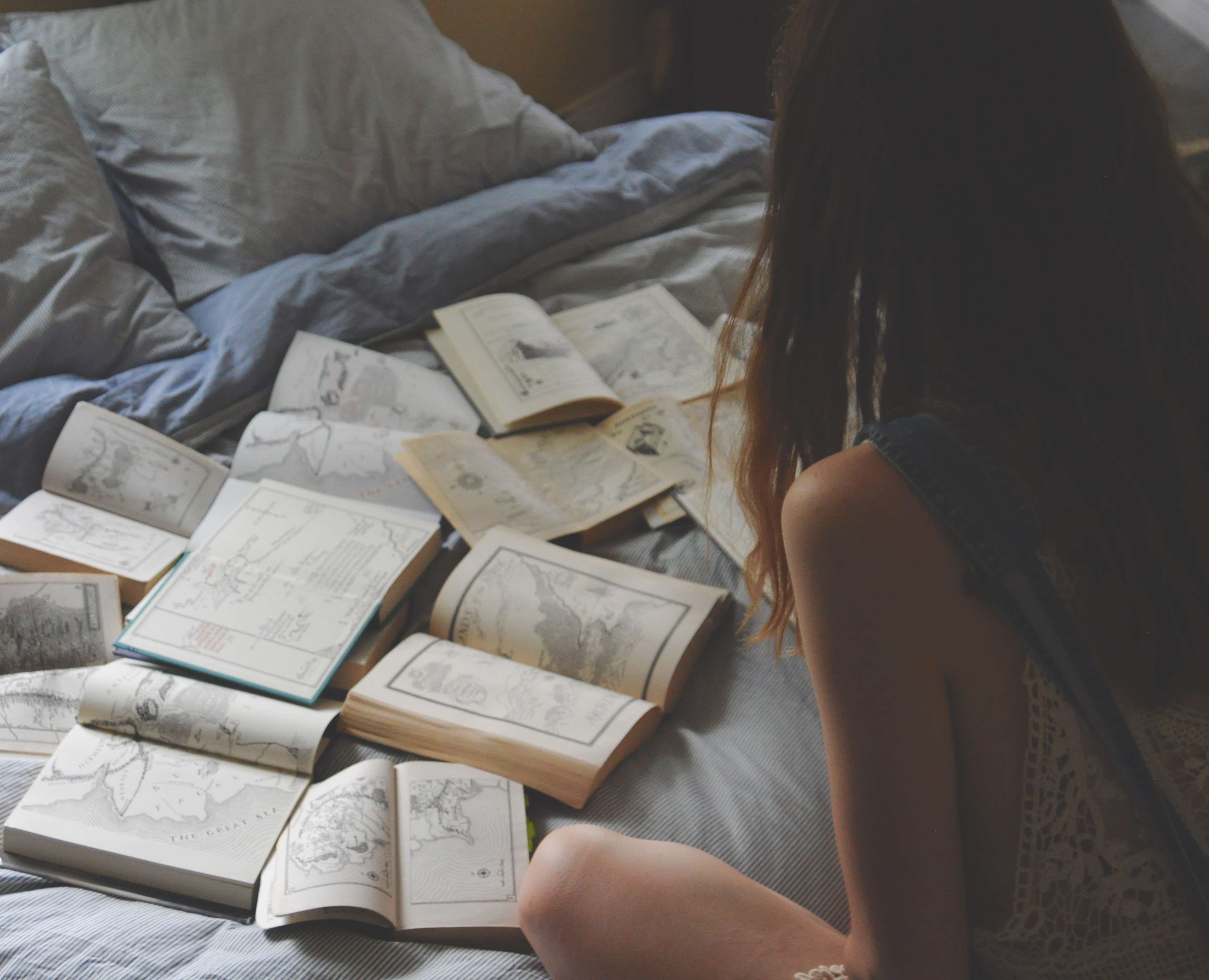
Showing posts with label J.R.R.Tolkien. Show all posts

Saturday, October 10, 2020

Beowulf, Fire and Flesh

There is a story about a book that is often talked about among scholars of medieval literature. 
 
The story occurred on the night of 23 October 1731, almost three hundred years ago when a tragedy struck in Ashburnham House in England. It was then that a fire consumed many great pieces of ancient literature. 

As fortune would have it, not among those that burned was what today has come to be the only surviving medieval manuscript of Beowulf. Legend tells that someone had the foresight to throw the priceless manuscript out of the window, thus saving it from the fire. Even so, none can deny that Beowulf was moments away from being destroyed by the flames.

The manuscript, however, was not wholly left undamaged. The edges were badly burned, the corners scorched, and while the words survived, the paper on which they are written is brittle and has only been preserved with extreme care.

The fame of this story among Beowulf scholars cannot be denied. What no one seems to talk about though is the deep irony this chance happening holds. Beowulf, after all, is a tale haunted by fire. Foretold in its outset is a future in which all that the dwellers of the tale seek to protect has been consumed by a mortal fire. Furthermore, the tale's teller, who in Beowulf looks back on a time and age now over,  seeks to keep alive what has been destroyed. 

How incredibly ironic it is that he almost failed because of a fire.

Still, the legendary tale of Beowulf the dragon slayer remain embedded like deep roots into literature, there mostly un-reached by the frosts of time.

How deep those roots go, no one knows. Indeed, no one can tell for certain the source of this epic tale or its origins. The legends of Beowulf the monster slayer have not survived by mistake, no doubt. But though the manuscript which was so nearly lost to us survives, we do not really know where it comes from. Even its original author remains unknown to us. 

Yet the narrator speaks vividly throughout the tale, moving through time as Beowulf grows old and eventually dies, vanquished by the dragons fiery venom. 

Even so, it is clear from the poem's first lines that in the time in which the teller writes he is already looking back to ages gone by. 

"Listen!" he writes

"The fame of Danish kings

in days gone by, the daring feats

worked by those heroes are well known to us."

From the very outset, the teller's words echo with reminiscence, astounded by the glory cast from days now over. 

Of course there is a bit of irony therein that the tale he is about to tell is the only one truly known to us. The heroes of the days gone by and the fame of the Danish kings that lived then remain to us only in fragments. Only that of Beowulf remains intact, though not unscathed. Though there is a bit of prophecy in king Hrothgar's words of praise to him after the monster is slain.

"You (Beowulf) have ensured that men will always sing

your praises, even to the end of the world"

With a little help from a scribe and a monk's foresight (to name a few), this rings true today, for indeed, Beowulf has been remembered.

  Beowulf in Heorot by Alan Lee 
(Note: My sincere apologies to artists Alan Lee and John Howe for burning your art for this project.)

The poem begins by accounting the building of a famous mead-hall. The battles of Hrothgar king of this great hall are accounted only in brief, for they lie outside this legend. It is the hall he builds and what it represents that truly resonates in this tale. 

"He," he are told, "resolved to build a hall,

a large and noble feasting-hall 

of whose splendours men would always speak ... 

In due course

(before very long) this greatest of halls

was completed. Hrothgar, whose very word was counted far and wide as a command, called it Heorot."

Needless to say, the common man no longer speaks of Heorot's splendor, just like the drinking of mead is a custom the meaning of which has been abandoned. 

Next the poem recounts how, here, in this hall of great splendor, the "warrior Danes lived joyful lives."

...until the hellish fiend 

began to perpetrate base crimes"


Thus, Grendel creeps up from some unknown lair, destroying the Danes' joyful lives. It is said that Heorot remained empty for 12 years after that.


"Thus, Grendel ruled, resisted justice, 

one against all, until the best of halls

stood deserted. And so it remained."

 Until Beowulf comes. (Remember that word: Until. It is a crucial word.)

Famously, Beowulf slays three monsters throughout the course of the poem, all of which have been probed and studied endlessly since slain by the famous warrior. In many ways, they are a mystery to us still.

The first to be slain was Grendel. He is described as a "hellish fiend", a "notorious prowler", and is a  "gruesome" man eating creature, said to be condemned by the creator himself. I will not here recount his slaying. It is of little importance when it comes to the force of fire in this tale.

The second to be slain is Grendel's mother, a more puzzling monster still. The poem describes her as a "monster of a woman" a "sea-wolf" with "ghastly claws". Otherwise, she remains mostly featureless, and thus, a mystery. But she swims with sea monsters and gives birth to fiends, that much we know from the story. 

Yet, despite these two monster's fiendish and possibly hellish origins, it is the third one, the dragon, that vanquishes Beowulf. 


Grendel's Mother by John Howe

I wrote a paper on this question once, for it puzzled me greatly that the dragon, a creature of flesh, fire, and bone, is the one to take down Beowulf the man. 

The two die side by side, each taken down by the other. And though, Beowulf proves victorious, it is only moments after the dragon's demise that he too dies, consumed by the serpent's fiery venom.

I no longer think it so strange now that the only truly fleshly creature is the one to slay the warrior. 

After all, the blood of Grendel's mother is enough to melt the iron of a sword. In the heat of battle, Grendel and the woman that birthed him are seen only in flashes, in a flurry of blows and swings. They remain mostly featureless. Truthfully, we will probably never fully know what the author's intent with these was. Indeed, they have been re-imagined and debated over ever since.

Still, the narrator makes it clear that there is something unholy about their nature, for they are not beings of flesh. Beowulf slays these apparently hellish beings as a younger man, and lives to tell the tale. Furthermore, he lives to rule Heorot after Hrothgar is gone. 

Thus, Beowulf rules into old age... Until the dragon comes.

Turin Turamber, The Children of Hurin, by Alan Lee

"It is not until he is himself is old and grey that the dragon appears, rising out of the deep where he has dwelt these last hundred years, sleeping on, unmentioned by the poem and unknown to men. The dragon comes into the story as if summoned by the destiny which binds him to Beowulf." 

So I wrote once in a paper discussing the question of why this fate befits the poem. I do believe somewhere within that paper I missed the point. 

Beowulf is slain by a creature of flesh, like he is himself. Indeed, even in the wake of monsters, in the end it is the battles of the flesh that prove fatal in this legend.

So, while the corpses of the fiends are never inspected after they are slain, the dragon's corpse remains, exposed under the light of day under an open sky.

Beowulf's men find his body there, lifeless in the sand. Beside him lies the creature. The poem tells us that it was

"a loathsome serpent...

the fire-dragon...

was scorched by its own flames."

How fitting this seems to me now, that the blood in the veins of the fiends was hot enough to burn the sword of the warrior who slays them, yet the dragon's own flesh can be burned by the fire he breathes. 


There is something I have not yet told you, reader. As I mentioned in brief, there is a prophecy at the outset of this poem. It appears right after the naming of the great hall of Heorot, the very place Beowulf fights to restore and later rules, the place he dies to protect. It is in this prophecy that there lies the greatest irony in all the poem. 

I mentioned at the start of this post the story of how the Beowulf manuscript was saved from a fire.We have already seen much fire in Beowulf. We have seen it in the fiery blood of Grendel's mother, and the fiery venom of the serpent that claims the warrior's life and scorches its own skin.

But there is a more fleshly and consuming fire in Beowulf, a fire lit by a mortal feud. 

The narrator tells us that the great hall of Heorot, the very hall the poem concerns itself with preserving, will burn to the ground. It will burn in a bitter feud between the Geatish people and the Swedes. It will be destroyed by men because of a rift of loyalty, thus maiming everything the tale of Beowulf celebrates: honor, glory, fame, and fellowship.

The narrator tells us this on page 3. 

Thus, we know before Beowulf even sets foot on the page that what he fights to preserve will not be destroyed by either of the three monsters that threaten it. It will be destroyed by men. 


We see the shadow of this prophecy come near in the poem's final pages. The poem ends with war on the kingdoms borders, now exposed without their warrior and king to protect it. Enemies surround its lands even as the smoke of Beowulf's funeral pyre rises to the sky. 

"There on Whaleness, the heroes kindled 

the most mighty of pyres; the dark wood-smoke

soared over the fire, roaring flames 

mingled with weeping ... 

until the body became ash, consumed even 

to its core... 

Heaven swallowed the smoke".


It is true that Beowulf survived time, survived fickle frost, and consuming fire. But it did not do so unscathed. Deep roots are not reached by the frost, which passes with the morning and fades with the seasons. But though we do not know when Beowulf was written, we know that by the time the poem was penned, these great ages were already over. 

The manuscript survives today, but it is a brittle remembrance of what Beowulf once symbolized. There are no more meadhalls; today, Lords give no rings for loyalty, and the monsters are all dead. All the dragons have been slain. 

One thing has stayed the same, though. Then, like today, it does not take monsters to topple kingdoms and nations. Men topple those themselves.

And as Tolkien wrote in this essay "The Monsters and the Critics", Beowulf is a poem about our land and our language.  

"(Beowulf) was made in this land,"he writes. "It moves in our northern world beneath our northern sky, and for those who are native to that tongue and land, it must ever call with a profound appeal –until the dragon comes."
 

Remember that word. The inevitably of until can crush the hopeful whisper of unless. As I already mentioned, Beowulf is fire-filled. With a fateful feud lingering on the horizon of its history, it reminds us that even a dragon's flesh can burn in its own fire; and what's more, that even men has hard to kill as Beowulf have been taken down by a dragon.


Wednesday, September 30, 2020

Why Tolkien Left Middle-Earth

Wisdom From Gandalf on the Nature of Stories

"It has been brought forth and must now go its appointed way in the world, though naturally I take a deep interest in its fortunes, as a parent would of a child. I am comforted to know that it has good friends to defend it against the malice of its enemies."
~Tolkien on The Lord of the Rings

 
In a letter that Tolkien may have never actually sent, he recounted a peculiar conversation he once had with a man at Oxford whose name he had forgotten.

He could recall little else about the gentlemen of mystery other than that he was well known, though ill-remembered by Tolkien later on, despite the interesting conversation he shared with him.

This conversation took place somewhere neigh twenty years after the publication of The Lord of the Rings. Though the exact date of it is unknown, it was by it that Tolkien believed to have discovered the answer to a well-worn question of his. Remarkably, the answer was, as Tolkien later recalls, offered to him as if by Gandalf himself! 


(some things), Tolkien claimed "may explain to some extent why it (The Lord of the Rings) 'feels' like a history; why it was accepted for publication; and why it has proved readable for a large number of different kinds of people... It does not fully explain what has actually happened."

What a strange question. Yet to be sure the answer cannot be horribly simplified by the simpleminded, one should note that Tolkien was not asking about the logistical explanation for his success. 

When a reader asks a similar question of the author (namely how a work was created? or where its inspiration came from?) it does not seem to the inquirer nearly as large a question. The word why is not used, after all, and questions that deal in where and how usually seem far more traceable than the the large untraceable why.

A great many readers did ask this of Tolkien. Questions like "where did your inspiration come from?" or "how did you come with these ideas" plagued him. As a younger man he took the time to explain the mystery of his discovery of Middle-Earth. As he got older, he had little patience for it.

But naturally, when the writer doesn't supply a suitable answer, the reader will try to solve the mystery themselves. Usually they will seek to do this in small ways, like examining the things they encounter that remind them of the work (such as other works of art), or inspecting the authors lives, both of which Tolkien hated. Some inquirers were more persistent, however. Many wrote to Tolkien, asking him for answers. Some were lucky enough to interview him.

Yet when the man whose name Tolkien could remember asked him a similar question (though greatly disguised by his words) Tolkien was suddenly and expectantly given an answer by someone whom one might suppose far wiser than he himself: namely, Gandalf. 

"I think I can now guess what Gandalf would reply...", Tolkien wrote. For just as Tolkien dismissed the inquiry, the mysterious gentleman fell silent, and stared "fixedly" and said, in a voice much like Gandalf's,

"Of course you don't suppose, do you, that you wrote all that book yourself?"


"Pure Gandalf!", Tolkien states.
And then, being well familiar with Gandalf and his ways, he considered his answer.

"I was too well exposed with G. to expose myself rashly, or to ask what he meant. I think I said: 'No, I don't suppose so any longer.'"

All in all, the conversation echoes of Gandalf's advice to Frodo. His words to Frodo in the Mines of Moria are not so different, in a way. No one can put one in one's place quite so simply and thoroughly as Gandalf, whether that be to put one back where one belongs, or bring one forth and out onto the greater way.

'I wish the Ring had never come to me. I wish none of this had happened.'
Gandalf: 'So do all who live to see such times, but that is not for them to decide. All we have to decide is what to do with the time that is given to us. There are other forces at work in this world, Frodo, besides that of evil. Bilbo was meant to find the Ring, in which case you were also meant to have it. And that is an encouraging thought.”


One cannot help but feel that Tolkien was likewise meant to find Middle-Earth and all that happened in it. (He always said that Middle-Earth was his discovery, not his invention.)

One could say a great deal about why Tolkien's creation has remained so astounedly successful. (I know I could). But perhaps that has little to with Tolkien himself and much more to do with those that aided him in its creation. C.S. Lewis and his youngest son Christopher Tolkien certainly come to mind.

But maybe it wouldn't be so crazy to say that Gandalf helped a little too.

One can easily chuckle about this notion. But it is, after all, a strange relationship an author has with their characters. They are not really "theirs", nor are they fully of them. Even those that resemble the author (as Tolkien claimed Faramir did) are not really theirs to keep.
The author has them only for a time, like a friend that they know and love for a short while who will one day move away. The author may at times wonder how that friend is doing, they might even consider writing to them, but it is unlikely that they ever will. 
Their characters have passed into the Grey Havens, a place only attainable from afar. One may catch glimpses of that distant shore, but neither reader nor writer will ever walk there in this lifetime. The pages of a book work the same way for us as the roundness of the earth does for the worlds of men: the best we can do is go back to where we started, travel round the globe, go there and back again, and start anew.

Eventually the author must let go of their characters. This is an inevitable truth. Even those that refuse to do so will eventually find that their characters are not the same; that they are less alive than they once were. Indeed, many writers suddenly find that they are unable to write about their characters. It is as if they aren't there anymore, living in the hole where they once dwelt; all that remains are the writer's memories of them and what they might have said or done in a given situation. But the story is over, and its characters, like its author, must move on eventually.

Many wise authors have abandoned sequels to their great works. Thus, their story ends well and its characters are allowed to retire (whether they pass into death and legend, or to have untold adventures on the road that goes ever on). And so, Bilbo walks down the road to Rivendell at the start of The Fellowship of the Ring, and not even Tolkien was able to follow.


In the same letter in which he recounted this conversation, Tolkien, in words that seem to rekindle Bilbo's own narrative tone, wrote that

"Looking back on the wholly unexpected things that have followed its publication ... I feel as if an ever darkening sky over our present world has been suddenly pierced, the clouds rolled back, and an almost forgotten sunlight had poured down again. As if indeed the horns of Hope had been heard again, as Pippin heard them suddenly."

And that is where the author stays, eventually: retired into the routine of their own life with abundant memories of their adventures, now behind them. His letters reveal just how often Tolkien would return to his memories of Middle-Earth, in one way or another, reminiscing about the events of his works like once lived adventures he had been fortunate enough to witness.

After all, Tolkien knew well that
"The L.R. (The Lord of the Rings) does not belong to me."

If it had, he may have stayed there forever; might have returned there often to walk in its hills or have tea with Bilbo. Indeed, one would like to think he could. But Bilbo doesn't live in Bag End anymore. 


What a sad thought this is. And yet, if one really thinks about it, one cannot help but feel that it is better this way. For all great adventures end eventually. It is only so that new adventures can be had, and a new Hobbit can come to live at Bag End. As Tolkien wrote long before his journey through Middle-Earth was over,

"So comes snow after fire, and even dragons have their endings."
(The Hobbit)


It was by discovering Middle-Earth that a desire was in me awakened to write and to create things that likewise arouse such fondness in others. (How marvelous it is to be fond of a place that one can carry in one's bag, in one's mind, and in one's heart! Only books can fit worlds in such little spaces; can cram worlds to explore and get lost in into words, and keep hearths to sit by and call home into paper!)

But reading Tolkien's letters has reminded me that all things have to end. Books always run out of pages sooner or later. That is the nature of things. But it is both a sadness and a blessing. For it is only in ending that they can become fond memories.


I may still be in the midst of my own adventure. And while I think often of the day when I can look back on all that I have said and done with fondness, I cannot forget to take the time to enjoy the journey for all the joys and struggles that it still has to offer me.

Even Tolkien had to leave Middle-Earth eventually, after all. But I am not yet ready to leave mine.
My book will run its course one day, and then the words will leave me. I may write about other things, but nothing will ever again be written about the realm I once knew and walked. Even an author can overstay their welcome in their world.

For now, I know that at least that it is not ready to leave me. There is much still to discover, and I am not finished with it yet.
 
On goes the road, as ever and always old stories continue to give way to new ones.


Thursday, July 2, 2020

Running Away with Fictional People: Writing Advice to Take you Off the Beaten Path

What to do When your Characters Don't Want What you Want


I read a quote once that stuck with me. I cannot for the life of me trace it, but this is the line as best as I remember it.

"I can't stop reading. The characters might do something without me."

This little line never fails to make me smile, for it perfectly captures the excitement of reading a good character driven story; of running off with fictional friends; of having grand adventures with a band of fanciful troublemakers, painting fences, or seeking treasures; sleeping in hay-stacks with wandering orphans; chasing characters who chase rabbits down holes, or crawling after them through little doors. In these situations, I don't mind feeling like the quiet friend in the bunch. In fact, there is never a better time to be the quiet friend, because everyone knows that the reader is the protagonist's closest and most reliable friend, usually being the one that follows the protagonist most closely, (till the pages end, that is).


But there's more to this simple line, where ever it comes from. It doesn't just capture the thrill of being a reader. It also encapsulates something I believe firmly about writing. In short, it suggests that characters can all too easily get away from us, go on without us, and undergo adventures or shenanigans long after the book is closed, the lights out, and the reader sleeping. 
 
Yet, while this idea is a thrill to the reader, it can keep a writer up at night. Indeed, the writer is in much closer association with the character than the reader that will later come to know them. For the writer, it can feel a bit as if the character is asking them if they can come out to play, or rather, pestering them with questions in the hope that the writer can explain their existence. Why did I have to do that? Why are we going there? What's the point of all this? Where is this story going? –These are the types of questions I imagine the character might be asking. But, of course, it isn't the character that is asking these things at all, but I, myself, the writer, the one spinning the character into their paper existence. Furthermore, the reason I am asking myself these questions is likely because I doubt the character's existence; doubt that they are in fact believable; that their actions make sense; or that they will feel real enough to the reader. It is a constant worry for any writer that their characters don't feel convincing enough, and frankly, it would be a great insult to hear that they were not.
I am fond of my characters, as any writer is. And I have come to be rather fond of these late night conversations with my characters, even if they often result in sleepless nights, in many ons and offs of the nightlight, and many quick scribbled notes, brief lines of dialog or descriptions of body language I do not want to forget in my sleep. I have come to enjoy these nights for the simple fact that I rarely get such one on one time with my characters; times in which I remove myself from the voice my narrator speaks in and start thinking in my own; start looking at my creation from the perspective of me, the life that created it. And, ironically, it is these late nights in which my characters keep me awake with the doubt that they are not real enough that my characters seem most alive to me.

I can honestly say that my wrestling with my characters does not go beyond these nights, and when the words and the rain comes, my characters take over the page. It is then that I feel a thrill like no venture as a reader as ever given me, for nothing will ever be quite as risky and as wonderful as setting a character free on the page and letting them do just what they want.


I have often heard the writely advice that a writer should control their characters, and while I understand the reasoning behind this, I cannot say that I agree.
In writing about fictional people (if that is something you have ever done, you will know what I mean), you will often find that your characters will try to get away from you. "My characters don't want to do what I want them to do," goes the complaint.
To this the sensible writer will say something like "What do you mean, they don't want? You created them, didn't you? Your characters will want what you want them to want." This is fine advice, over all.
It is, in fact, a logical argument. But the argumentative side of whether you should wrestle with your characters by editing out the parts of them that defy you and your vision for the plot is beside the point. What you should really ask yourself is this: What kind of story are you really writing? Are you writing about people, or about situations; about personality, or plot? If your characters aren't enacting the plot the way you imagined they would, maybe there's a reason for that. Maybe you should go with it. It is the character driven plot, with all its curious children and never-yielding tricksters that makes readers feel like they're adventuring with a friend, as the quote above suggested. Readers, after all, love to read about people, about fictional personalities, both grand and wonderfully simple (think of any Hobbit you ever met). When a character makes decisions which have been forced onto them by the writer, the reader can always tell because the reader is themselves a person; and when a heart tugs at you or a curiosity probes your mind we can rarely ignore it.

Ultimately, there is a very simple reason for this. We humans, while still capable of intense logic, are at the core of our being creatures of wants, of dreams, of desires. That's why history, both real and mythological, is full of people falling prone to the illogical sides of themselves; making mistakes because of it; wheeling in mysteriously gifted horses through our gates; ringing bells to awake long-sleeping witches; eating forbidden fruits; kissing sorceresses; crawling over walls to break into locked-up keeps. Characters, like people, make irrational decisions. And while I am not arguing that you should allow irrationality to rule the plot, I believe nonetheless, and very firmly, that a wonderful and wild story is created when we allow our characters to make these decisions, even if they are irrational or inconvenient to the narrator.

Consider, for example, Tolkien's Lord of the Rings. This is undoubtedly one of the most famous fictional epics of all time, and it was written because a man (namely, Tolkien) followed a Hobbit out of the Shire totally unknowing what he would find outside its borders. I myself am convinced that if Tolkien hadn't set his protagonist free from his outline and the plot's expectations Frodo would still be named Bingo and the world would have lost one of its biggest fictional adventures ever put to the page.

Maybe my advice to you is simply to write like Tolkien. Because, although the edits later on might be extensive, I believe the most unpredictable and unexpected stories occur when not even the writer can foresee exactly what lies ahead. Yes, this may be risky, maybe it's even dangerous. But you can't have adventure without a little danger. And, if you're one of those writers who writes because they first loved to read, then write like you love to read. Don't just take a reader on a journey. Go on a journey yourself. Even if you know the destination, or plan to make a few stops along the way, at least be daring enough to be curious, to run off from the charted course, to explore un-plotted territory.

What it comes down to is this: If your characters are trying to run away from you, maybe you should let them. You never know where they might take you. After all, what more could a writer want than to write about characters that actually have wants of their own.

Thursday, July 27, 2017

The Road Goes Ever On


These pictures were taken in the Dolomite's in Italy during my grand European adventure last year.
I have wanted to share these pictures with you for quite some time and try and capture this experience. But, somehow, I don't think I could capture with mere words how incredibly breathtaking it was.


As me and my Dad (who thankfully took these fantastic pictures and so helped capture what my words cannot) made our way up the mountain side, and the air got thinner and thinner, I could hear my heart beat in my ears. It seemed to come from all around me. I can remember so vividly the feel of the wind in my hair and the clouds in my lungs. 


We climbed right into the sky, and, when we finally reached the top, despite the fact that I could hardly muster the strength to take another step, looking into the fog and seeing the path beyond, I wanted nothing more than to keep going; To follow the road, and discover what was beyond the fog. 
But the clouds were getting thicker and a storm was beginning to brew. It followed us all the way down the mountain and we only made it home just in time. I don't think I would have had the strength to go much further.   

Rarely have I found so much peace in silence and been so at a loss for words. One day I will go back and see what lies beyond the fog. And this time, I won't turn back. 


“The Road goes ever on and on
Down from the door where it began.
Now far ahead the Road has gone,
And I must follow, if I can,
Pursuing it with eager feet,
Until it joins some larger way
Where many paths and errands meet.

And whither then? I cannot say?"


~ Bilbo; The Lord of the Rings by: J.R.R Tolkien


Wednesday, April 26, 2017

Farmer Giles of Ham

Considering that Tolkien is, and has always been, my greatest inspiration, it should come as no surprise that I loved this book. 
Although it was far more lighthearted than some of his other stories that I have come to love (exp. Lord of the Rings & the Children of Hurin,) it's still filled with Tolkien's familiar voice.
It is rich with his simple kind of warmth and his witty sense of humor. It introduces yet another Dragon with a strong personality, an unexpected, and all together unlikely hero and, of course, an absolute brilliant adventure. 
There is just a golden comfort that sustains through every one of his novels that makes me feel at home. Rereading his books is like reuniting with an old friend or returning home after a long time away. 


Photo credit, like always, goes to my wonderful Dad. Check out his website here.


I also love the story behind the story. For those of you that don't know this, Farmer Giles of Ham is one of the stories Tolkien invented to entertain his kids. J.R.R Tolkien first came up with this fanciful fairy tale when his family was unexpectedly caught in the rain during a picnic. The family took shelter underneath a bridge and Tolkien invented the tale to pass the time. This just goes to show that the best things really do happen unexpectedly.


Friday, April 22, 2016

Word Conductor

I used to pretend I could read. I would open a book and invent a story, all the while telling my brother I was reading to him. When I was 6 years old, I learned how to read, for real this time. I was 8 when my Dad read The Hobbit to me for the first time. That same year I wrote my first story.
In the years that followed, I would reread The Hobbit again and again. I would also discover legions of other books. I fell in love with literature numberless times. I would find myself lost in a book more often than in reality. 

When I was 12 years old I started writing the novel that would become my greatest passion. That same year I won an award called the Future Novelist Merit Award. It was the moment my English teacher told me that I would be the next Tolkien that I realized this was all I wanted to be.
In the years that followed that aspiration never faltered. Just when I thought writers block had gotten the best of me I would stumble upon more passion to sustain me. Pages get caught in my hurricane. Pencils get shredded to the stub. Notebooks get inked. What once was blank and paper-thin is made bountiful enough to get lost in.
Then, everything changed, and as a result, I stopped writing.
My year away from writing changed my life completely. No pages were filled. My finger tips became unfamiliar with pencils. Words began to fall off pages. Sentences were left unfinished. And I, the girl that used to dance and breathe with words, I think she forgot how to feel. 

I searched for life in a lot of places. I looked for a substance that could fill a void. But I could not fill oceans with water droplets. I could not rage a storm without breathing. I could not fill pages without passion.
So, instead of writing about life, I started to write about death. Instead of writing about emotion, I learned to write about the pain of not feeling anything.
Somewhere in that fight, I heard his calling. I always wondered where this passion came from, and now I asked myself where it was that I had lost it. The Lord called out to me, and that was when I rediscovered my sustainer.  

This is my calling, and I am the listener. Now I have discovered that I cannot cease to fall in love with this aspiration. Plot holes have been filled with mountains. Writers block has been blown away by breezes, and the words have found me yet again.
My palms are stained with pencil. My finger tips are tinted with ink. They have called me book worm, but really I am the aspiration of a master novelist. These words are my addiction. These words tell me that I am still alive. These words, they are my catastrophe, and he is the conductor.