The Sisters Grimm is a series I devoured as a child. The dark world inside this nine book installment utterly engrossed me. Indeed, if a child was ever addicted to a series of books, I was hooked by the nose to this one.
I remember spending late nights reading them, flipping pages in the otherwise silent house, blinking through tired eyes. Each time I'd get to the end the words to be continued would stare at me, blurry and inconclusive, leaving me hungry for more.
Never before had I found a series that ended with such twists: with dark faces staring at one from the dark, leaving one at the climax with the epitome of a horrible betrayal, enough to make one's heart twist up inside. Sometimes strange monsters lured one into secret places, offering secrets of the plot. The desire to follow them into the next chapter and so the next book would be maddening.
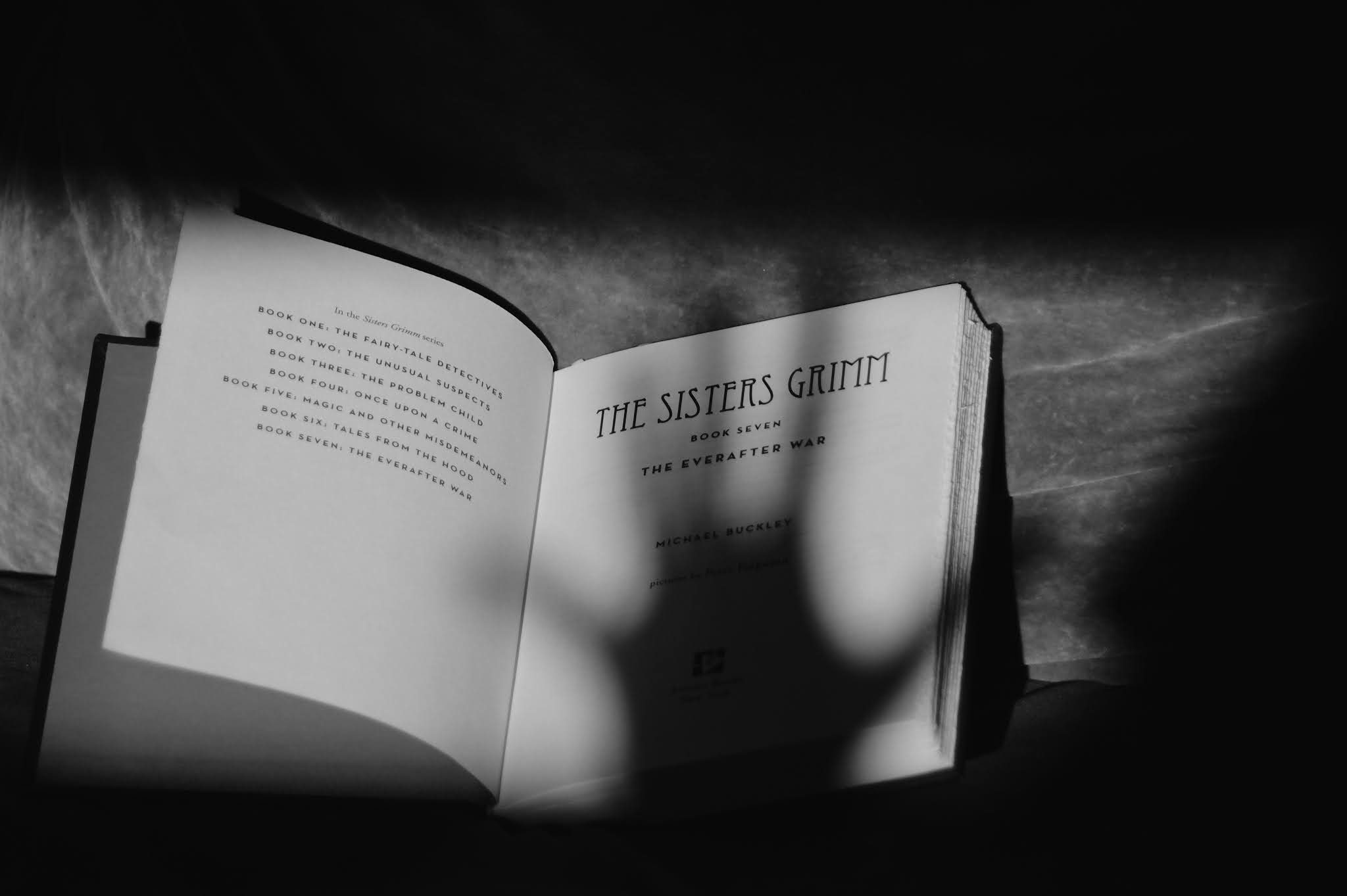
But, everything is better when you are a child, after all, and so, for a long time, I was hesitant to return to this grim world I once so devoured, fearful that my adult mind would find too many faults within its pages.
As an adult, it is often hard to be anything more than charmed by the emotions of a protagonist meant to appeal mainly to children.
I was afraid that meeting some of my favorite fictional characters in this adult form of mine would disillusion me. They would become shallow versions of themselves. I would see through their sorrow, neglect to fear or be disturbed by their ugly and heinous ways, and find the once glorious humour bland and childish.
Little did I know that The Sisters Grimm is an adult's tale full of the vengeful, the cruel, the broken, the abused, and the murderous. The most colourful characters are the children. Puck alone can stand for this. But the most interesting personalities were undoubtedly the adults. There was Mr. Canis with his dark inner demon; Uncle Jake with his own personal addictions and grievances. Even Prince Charming, a character that is usually two dimensional, often utterely annoying, was complex and deeply complicated.
This, of course, is all obscured by its imaginative story, fully stuffed with fairy tale characters, all beloved and hated in their own way. Still, hidden under its child protagonist's noses are themes of grief, addiction, anger, and intense mental illness, all seen by their innocent eyes, the depth of them always misunderstood, left in the shadows.

The first character we meet that struggles with a dark secret is Mr. Canis, an old man with a monster living in his head. Throughout the series, we watch Mr. Canis suffer under this perpetrators strains as slowly the old man loses himself to the monster inside of him, the Big Bad Wolf.
Eventually, Mr. Canis is cruelly locked up for his questionable criminality. Yet, while we know that Mr. Canis is not evil, we also know that he is a danger, and so, the issue is, to say the least, complicated. Sabrina, the stories protagonist, is kept up at night worrying about the possibility of what might happen should the Wolf be set free, knowing full well that, according to the popular fairy tale, the has Wolf has eaten someone's grandmother before.
In Mr. Canis' his big watery eyes we see a man in pain. But in the man's shadow the children catch glimpses of a corrupt past that even the love and support of the Grimm's cannot mend.
It
is often in their descriptions that the narrator cues us into the fact
that there is more going on than meets the eye. I remember vividly the
way the narrator describes Mr. Canis to the reader: his constant weariness; his
frail, weak form and his thin grey skin. More often than not, he
retreats to his rooms under presumptions of a headache or a bad nights
sleep. Of course, this is not what is really going on.
Yet,
while other stories would cast this man into a vile role, perhaps the
evil villain's main monstrosity or a cruel schoolmaster with a hidden
mental illness, in The Sisters Grimm this is the face of the
Grimm Sisters sole protector, a man with a dark past and deep bedded
flaws, but a man who would give anything of himself to protect them.

Throughout the tale, we see many characters turn to the Scarlet Hand, an evil conspiracy the master of which, for much of the series, remains a mystery. Yet few (if any) of these characters become a part of the conspiracy because they are simply evil. Often, it is much more complicated than that. Time and time again, this series breaks these traditional stories apart, splitting them open with sharp realities, taking fairy tale villains and redeeming them just as it uses once good characters for evil.
So, it is not the story itself that is complicated, but the people.
Evil stepmothers, power greedy princes, even monstrous beings are, in the end, just people in pain.
When we finally do learn who the master of the Scarlet Hand is it is not the shock that lingers.
I remember the surprise of it all, but in retrospect, I also realized the clues had been there all along. In the end, what made it so effective wasn't just the fact that I, and others who read the series along side me, didn't see it coming, but that we didn't even consider it. Not only did we totally miss the signs, we neglected even to recognize the character as capable of such deep driven pain, and so, the distraught core of their being is the real shock; that, and the total neglect and disregard to the character's suffering which no one, not even the reader, had seen.
Thus, the twist and betrayal of the master's big reveal didn't sting nearly as hard the fact that I, the reader, had never thought that enough hurt could drive anyone, even the most beloved characters, to such evil intent. The real horrible truth is that we cannot really blame them. When the evil master tells their story, we cannot deny that they are right: we really didn't see their hurt.
Ultimately, it is a revelation to break your heart.

I
cannot think of any other children's story in which love interests are
killed off and beloved side characters left to grieve them. I cannot
think of any children's story in which, looking back, I see drunkenness
in the eyes of a man once full of spirit; no where else do I look back and recognize between the lines of the narrative the mark of bitterness in the frail face of an old man who made too many mistakes in his youth.
I
do not know of another tale where abused children are disguised as
psychopathic villains only to be eventually redeemed and restored to childishness; or where close friends, often enough neglected, eventually turn on you; where good people sometimes do evil for fear of losing those they love.
I
implore you, parents, do not hide books like these away from your
children. It would be foolish to think that they do not pick up on
these things in the real world, that they do not see snippets of these
adult shadows already. Since you cannot hide away the bad realities, please, do not try to refuse them their fictional echoes.
Let them see some snippet-trauma and some fragmented-grief in books like these. It is easier to
digest when there is also some magic and wonder in it.
Perhaps some
day when they are older, they will return to books like these in their
adult form and realize that they let them understand the world a little
better: that seeing these things incorporated into a story woven out of fairy tales took away some of the shock of it later. Please, let us give it to them softly.
Most importantly, let them see that bad people are also hurt people; let them see that wounded children don't always look like weak hurt things. More often, they look like bullies themselves.
The world would be a far better place if more people, children and adult alike, realized that there is always more to people than meets the eye. There is always more hurt in the
shadows, and people do terrible things when they are not seen. In this real world, there is nothing worse than unseen suffering.
Sometimes the best thing you can do for someone is see them. I can truthfully say, The Sisters Grimm helped me learn how.


