Showing posts with label Neil Gaiman. Show all posts

Sunday, May 30, 2021

Half-Adult

The Ocean at the End of the Lane

On the day I started rereading The Ocean at the End of the Lane something stung me beneath my right eye.

I didn't notice the stinging itself, but I did notice that my eye was itchy and puffy afterwards, and, going to look into the mirror, I saw that it was red and swollen. 
 
I was disturbed by the reflection looking back at me if only because it offered a glimpse of what my face might look like if I were old. It was as if I had suddenly become half aged. The skin beneath my one eye grew heavy and red, folding over itself like swelling wrinkles. 

I shuddered, for I knew that it was in a similar fashion that the fiend that calls itself Ursula Monkton enters the story, burrowing its way into the protagonist's foot in the form of a grey worm. The ancient and strangely powerful Hemstock's refer to its kind as a flea. I thought it a fitting picture and I in turn wondered what it was that had bitten me. 


The Ocean at the End of the Lane is an amalgam of a book; only half aged; one half adult, the other a child. Indeed, it defies every attempt to force it into an age. Neil Gaiman, the book's own author, is still not certain whether it is a book for adults or for children. 
The book's child protagonist, a boy of 7, certainly makes it seem a book for young people. At first glance, at least. But, as Gaiman himself put it, if it were to be a book for children he might have had to remove the scene in which the boy's father, in a fit of unexplained madness, tries to drown him in the bath.  
 
The Ocean at the End of the Lane is questionable, to say the least. It is the only dark book featuring a young protagonist I have ever felt necessary to withhold from too a young a reader. Sometimes it is inappropriate; and yet, I think it is best to read it as if you were still a child. Indeed, someone too adult might try too hard to understand it. This would be a mistake, for in doing so it is likely that they will not understand it at all.

I have written before about the adult horrors in books meant for children. They are, as I point out in my post titled The Adult Shadows in the The Sisters Grimm, made more horrific because they are placed in contrast to a child's world inside a child's book, and so, they become all the more terrible because they are not supposed to be understood in the least. 
They are rendered the stuff of horror not because the adult world is necessarily horrifying, but because there is something frightful in it when seen from the perspective of a child.
 
But this is, of course, not only true in fiction. Few of us like to think about it, but the adult world once seemed just as alien and arcane to us as the dark powers inside this book do to me now.


There are moment's throughout every child's life when they realize, with a thought that feels a lot like a shudder, how little control they have over their own world. I grew up in a safe home, and my parent's tried to shelter me from the outside world like any loving parents do, giving the hard truths to me slowly and in good time at the appropriate age. They kept a close eye on the movies I watched and sometimes on the books I read, telling me just enough so that I would know what types of things to stay far away from.

Still, sometimes it scared me to know how little I knew; that life crippling mistakes could be made completely by accident, by the ignorance of trusting a stranger too well, or in messing with something dark disguised as just risky enough to be exciting. 

There remains ever on the edge of the child's life the possibility that things could fall out of control, and they, being small and mostly helpless, could do nothing about it. The idea that a child could somehow ruin their own life by not being adult enough, not knowing enough, or simply not knowing any better, makes me gulp. 


There were earlier glimpses in my own childhood before the time my parent's took a book I was reading away, telling me there were devilish themes inside of it. 
 
I was taught to be paranoid of strangers from a young age. I still have bad dreams about being taken by an unknown person sometimes, and although these dreams are nightmarish, they still do not compare with the real shuddering fear I felt when I was young and unable to judge what was dangerous and what not; such as the time an old man pulled over to talk to me when I was playing in my driveway, and I, forgetting everything I had been taught about being wary of strangers in a moment, stepped closer only to hear my dad shout my name in an alarming tone. 
 
I felt foolish afterwards and insecure, and even though he turned out to be a kind man (my dad spoke to him after I had left) I knew afterwards that there were risks out there I had no idea about. It was scary thinking that the things I read and the people I talked to could turn on me or do me ill. Worse still was the thought that I could not see it coming and so would be helpless in preventing it from happening.
 
The Ocean at the End of the Lane is, as I've said, half-adult. This is represented to me in the way the cover has folded over, as if someone (probably my little brother who borrowed it once and returned it in this condition) has only half looked at it, not daring to open the book all the way.
It is, after all, a book that is only ever half read; whether through the eyes of a child who does not recognize some of the adult things going on behind the windows, or an adult recalling what it felt like to be a child and have no control when their world changes, the book is designed not to be understood, or rather, to be only half understood. 

So, when the boy's father tries to drown him in the bath, we have no idea why. We know that he is not a violent man. Indeed, the story makes a point of telling us the boy's father has never once hit him. Still, any one that has ever had a short-tempered parent knows how scary it is to stand in their shadow, even if they do not touch you or hurt you, the angry look in their eye is enough to cause some level of fear. Thus, we do not need to understand why the father is harming the boy. Indeed, that is what makes it feel so scary and so very real. No child ever really knows why they are being harmed or why their parent and guardian has suddenly turned on them.
 
Having been a child once, everyone should know the fear of not being understood and of not understanding. With our limited language and perception, how can we explain when a teacher was cruel to us? When we do not really know what happened, much less how to explain; all we can really know is that something felt wrong about it. It is almost as if it is too adult for a child to talk about. They can not explain why an adult does what they do, neither can they always know exactly what was wrong about it. Children, while having a great sense for wrongness and injustice, are less than inept at explaining how they feel and why.
Furthermore, how can a child  know that, when an old man pulls over to talk to them that he might have ill intentions? How can a child even imagine what he might really be thinking? 

In The Ocean at the End of the Lane Ursula Monkton knows this, and she exploits this, turning the boy's parent's against him, making up lies about him, telling him that he will not be believed because he is a child and she is an adult. 
 
We do not know what Ursula Monkton really is, but she appears in the form of a grown-up, and the book makes this something truly horrible, telling us that "she was power incarnate.. She was the storm... she was the adult world with all its powers and all its secrets and all its foolish casual cruelty.


By the end of the story, the boy, now himself grown, has forgotten about the horrible events of his childhood. He does not remember Ursula Monkton. He no longer knows that his father once tried to drown him. 
This is necessary. It is necessary because, if we, like him, remembered for a second what it was like not to understand a world of change and unseen danger and out of control strangers, well, then we'd realize for ourselves what Lettie Hemstock, the eternal eleven year old of this story, said so well 

"The truth is, there aren't any grown-ups. Not one, in the whole wide world." 
 
If we remembered what it was like to be so and to know oneself to be so we'd realize with horror that not much has changed now that we are older. The truth is, we are all just children who aren't young anymore, and so we are half. Half-child, half-adult, only ever half understanding, only ever half-understood; and, being so, there is still and ever the lingering possibility that our world could cut loose from our control.
 
In which case this hybrid of a book, itself something compound and cross-stitched, can only be for us half-beings. 


Sunday, February 28, 2021

The Bedeviled Book

 Which You'll Either Displace, Be Divested of, or Read to Demolition

I have heard tell of the legendary work of fiction that is Good Omens. Yet, while I knew the basic premise of the plot and was aware of its massive fan-base, it was not these things that had first reached me. 


The first time the infamous reputation of Good Omens entered my awareness it was on a post online which discussed the book's notorious reputation for being stolen. The writer rued the amount of copies they had had to purchase in order to replace those that been regrettably lent to a friend who, naturally, neglected to return it. 
 
One might ask why the unfortunate soul continued to lend their precious copies of the novel to people, repeatedly not learning from their mistake. 
It could well be that the book, in a nefarious effort be read by as many irreproachable readers as possible, simply wanted to leave its former master. Perhaps the master himself (the book's original owner) had become so possessed by its wicked humour, masterful plot, and clever devils that they were at the mercy of its will. 
Or, conceivably, the book may just be that good. 


I later heard of other strange habits the book had acquired. Apparently, the novel has a nearly diabolical way of turning strange shades of brown, being dropped in the bath, or totally falling apart at the spine so that it must later be carried in a plastic bag like a dead thing.

I certainly do not think that any of this is the author's fault, both of whom I much admire. Unless of course, somewhere along the way, a curse of destruction was placed on it in a ploy to sell as many copies as possible. 
The book's foreword, however, will tell you about the author's puzzlement at the state of some of these books which they later find themselves signing, as if taking credit for the disheveled thing in some ironic way. So, unless we are to accuse them of lying, one can only assume the books bedevilment is a thing entirely separate of them. 

I was cautious when reading the book. I did not take any baths with it. I kept my tea at a safe distance. I made sure to keep it far away from open flames, especially when leaving the thing unattended in the same room as my scented candles. 
Yet as I read Good Omens I quickly realized that no amount of caution was enough as not long after beginning the thing my copy literary started to skin itself alive, like some sort of snake. 
It began slowly at first, and though I made sure not to pick at its dead skin, trying hard to avoid touching it at all, every time I took up the thing the damage seemed to have only gotten worse. 
 
Meanwhile, the cheeky little devil on the cover looked so cocky and calculated that I found I quite mistrusted him. I certainly had not heard him on radio 4, though he kept telling me that I had. Perhaps I need to start paying closer attention when Freddie Mercury comes on. 


I finished the novel late one Thursday night, exhaustion looming over my head. I thought it would be the end of it all then, as there were no obvious stains or tears beyond the continual shedding of its plastic skin, when, to my own surprise, I received a confession that made it all click into place. 

It could not have been closer to the end of the book even if it had tried. Luckily, I read every word, down to the author's bios in the back. Terry Pratchett went last, relating from beyond the grave that "P.S. (Neil) really, really likes it if you ask him to sign your battered, treasured copy of Good Omens that has been dropped in the tub at least once and is now held together with very old, yellowing transparent tape."

Pratchett, you sneaky bastard. It all makes sense now. 
 
These were my first thoughts as I read those words. Then, before I knew what I was doing, I went online and ordered myself some clear book-tape. 
Only the best for the best, that's what I say; and if Neil likes it this way, who am I not to oblige?


Sunday, February 14, 2021

From Dreams to Domination

:The Drastic Transformation of the Cinematic Universe as seen through Two Books Meant for Children 
 
Whatever goes into the process of deciding what to read next, one cannot argue that it is largely open to coincidence. Any number of things can influence a choice that seems so fundamentally simple, and so, I usually don't overthink it. 

The reason I mention this is because I recently read two books that were mediocre at best. But they struck up an interesting discourse when placed next to one another. Other than their target audience, the books did not resemble each other. Both were books meant for children, and both were discovered in the middle school library where I work. The genre and setting, however, were very different; even its orphan protagonists had little in common with one another beyond their own orphan-hood. 
And yet, at its imaginative core, both works offered a look at a young mind's relationship with the stagnant television. When placed opposite one another, they told the tale of the ever changing world seen inside the screen, which has descended down from its wondrous dreamland and been slowly transformed into a device of frightful domination.
 

The first of these books was The Invention of Hugo Cabret, which I am sorry to say was a grand disappointment. I remember being entranced by the film, and admit, I was likewise enchanted by the imaginative pieces within the book. 
It being so, I found it a horrid shame that the book was so poorly written. Indeed, I quickly realized that any magic the story holds is borrowed from its influences, namely, Georges Méliès, and even this was largely harmed by the awful writing. (I did not think this possible, but alas, it seems it was.)
 
I will not speak more of it here, only say I can at least credit the film version with introducing me to the first snippet of Trip to the Moon which I ever had the pleasure of seeing. I remember that I was immediately captivated, and, although I do not remember much else about the movie now, that image has never left me. 
I later wrote a short story inspired by it. Evidently, even just a few brief flashes of this early cinematic masterpiece seen through the lens of another film entirely was enough to influence my imagination (Read the short story here). 
 
The second book, which I have not quite yet completed, is none other than The Mysterious Benedict Society, which, while it started off wonderfully mysterious, has since become rather tedious. 

Indeed, nothing all that interesting might have come of reading these two books if I had not put these two stories in conversation with one another. 


I have already talked about the wonder that is the film world in The Invention of Hugo Cabret. Georges Méliès, the only character that was at all interesting in this narrative, is based off the real life visionary, illusionist, and film director by the same name. (For those of you who don't know him, look up Trip to the Moon on YouTube. You will not be disappointed.)
 
Méliès is rightfully credited with creating the stuff of dreams. As the book puts it, seeing one of his films was like dreaming in the middle of the day.

The Mysterious Benedict Society, though, has an entirely different take on cinema, or, as it was more recently called, television. In this book, television and even the radio are dangerous weapons used to send out hidden messages meant to control a nearly dimwitted society. 

The really strange part is that both views on film are true, in their own time and scope. While the cinema of the past awakes and entices the imagination, making dreamers of its audience, today's movies more often than not leave its audiences feeling uninspired, lackluster, and unsatisfied. 


While The Invention of Hugo Cabret acts as a sort of love letter to the works of Méliès, seeking to plant an adoration for classic cinema in its child audience, The Mysterious Benedict Society reads like a warning which, at the very least, seeks to create a wariness towards television in its young readers.
 
When the protagonist of The Mysterious Benedict society is asked on one of the mysterious tests whether he likes watching television, he almost answers yes. But then, upon further consideration, he realizes he really doesn't enjoy watching television at all.
 
Part of the tragedy is that many modern films have indeed become something trite, even benumbing. But the greater misfortune is that most of us don't seem to mind it. Indeed, we often don't even think long enough about it to realize that perhaps we don't like watching television at all. We've merely been entertained enough by it not to mind it. After all, who thinks twice about something that lets them turn off their brain so effectively? 


This is not to say that all modern movies are bad. Indeed, some are quite fabulous. 
But one cannot forget that the same thing that used to nurse children into dreamers now harms their minds, leaving them feeling lackluster, forcing them to slowly lose interest in other activities. One quickly sees where the novel gets its ideas of a dimwitted, thoughtless society.  
 
It is easy to preach everything in moderation, and yes, likely too much television is part of the problem. But even so, many modern film makers have become lazy and money obsessed, pumping out films with so little heart in them, they feel plastic and unreal.
The same stuff that used to inspire dreams now spawns imaginative horrors like Neil Gaiman's Media, a godly being that commits mass menticide by speaking through the voice of your television. 


There is indeed some horror at the core of The Mysterious Benedict Societies and the cautionary story it tells about television's powers for evil. After all, the conspirators behind the mind control ploy use the voices of children to send out their secret messages. 
That is ultimately how society is turned: with children's voices repeating dangerous ideas, though they themselves know not where they come from. 

In the end, the only conclusion one can come to is that the cinematic universe was a far safer and more simple place when film merely awoke a desire to dream instead of these slow killing apparitions.


Friday, September 4, 2020

First, They Must Lose Their Parents

Why Kids Love Stories that Make Them Spook and Squirm
 
 Sabrina sees her parents in the mirror: The Fairy Tale Detectives.
 
I have often noticed that there is an uncanny pattern to be traced throughout the course of children's literature: the most popular children's tales are the dark ones. 
  
Even if they do frighten them, it really does seem that children like to read them. There is something about spooky stories that fascinates them. Stories like these are far darker than the fairy tale versions we'd like to imagine. Some adults even go so far as to forbid their children from reading them. Whether or not there is any real danger to stories about monsters and evil is yet to be proven. What is revealed here instead is that adults seem to fear these literary monstrosities more than their children. Evidently, these are not the books they'd have their child read for fear of what lies inside of them. Doubtlessly, in their mind children's books should be far lighter and fluffier than they are in reality. One might say this is a fairy tale version of the truth.
 
The irony in all this is, of course, that fairy tales have always been dark. Some of us have just forgotten.
 
 The Wolf Shows its Face: Little Red Riding Hood.
 
This phenomenon goes back to the wildly popular fairy tales once collected by the Brothers Grimm. Yet modern children's literature continues to follow in these dark footsteps. A Series of Unfortunate Events will not stop reminding us that it is a sinister and unhappy tale; Roald Dahl, the most popular children's author of all time, is full of the macabre and the disconcerting. But it doesn't end there. Stories like Neil Gaiman's Coraline are horrific enough to alarm adults. Gaiman himself claimed that it is the "strangest thing" he had ever written. He wrote that,

"It was a story, I learned when people began to read it, that children experienced as an adventure, but which gave adults nightmares."
 
An adult may puzzle over this. Indeed, a strange change comes over the mind of the practical adult when they find out that most children prefer tales about monsters and evil as opposed to books containing more comfortable and childlike ideas. I myself read these dark tales as a child, and I read them still, for they fascinate me to no end. Though the things that interest me about them now are not the things I liked about them as a child. Indeed, I never realized them then. I loved them because they were about adventure, because they thrilled me, and sometimes made me squirm. 
 
 
 The Jabberwocky: The Problem Child.
 
I believe it was in part these books that inspired in me a desire to free myself of my parents. It seems like a harsh or even humorous thing to say. Yet just how far a child dares go when they run away from home varies (it usually is a matter of blocks, but some are bolder than others). The steps halt and the tears come when a child runs to the extent of their desire to be parent-less and realizes that the big, frightful and altogether unfamiliar world is somewhere outside their door.
But, of course, this never happens to the children in the stories. Red Riding Hood does not turn around when she runs into the wolf, and despite what the rational adult would have her do, none can deny that at least Red Riding Hoods exertion into the deep dark woods and away from her mother made for a good story.
 
 The Deep Dark Wood: May Bird and the Ever After.
 
  Little Red Riding Hood meets the Wolf: Little Red Riding Hood.
 
It remains a rather obvious truth that even children's tales without monsters are usually about orphans, and, if they are not orphans, the protagonist's parents have been lost somehow. This tradition began with our first tales about children; classics like David Copperfield, Oliver Twist, Huckleberry Finn all feature children that are somehow parent-less, whether their parents are deceased or simply too incompetent to provide care. 
But, though the villain's face may change from one tale to another, as does the perpetrator that took their parents away, when it comes to children's stories, the adventure almost always begins the same way: First, the child must lose their parents, then the journey begins. 


Orphans: The Fairy Tale Detectives.

Alone in the World: The Wide Window.
 
By removing the children's guardian, they are cut loose into the world, sent adrift into trial and adversary, sometimes even into horror, all of which they will have to deal with on their own. Thus, Alice's mother does not seek her in the Looking Glass, Red Riding Hood goes into the woods alone, Coraline's parents do not crawl through the little door after her. 

Of course, no child would adamantly wish this fate upon themselves (I hope). Nevertheless, orphan-hood is romanticized, not so much because it is desired, but because it makes for a good story. If the child is parent-less, they must make their own way, find their own place. If there are monsters under their bed, there are no parents to check for them; they must take a peak themselves. If a scoundrel is after their fortune, they must outsmart him alone. If their house is being invaded by monsters, they must fight them off without adult aid. 
Thus, adventure becomes inevitable. 

Herein lies, I believe, the true appeal to the mind of a child. It lies between the motherless child and the monster, for it is here that the book reveals in full the idea that resonates so with the young mind that reads it: it reveals that the child can be capable, courageous, even heroic.

Inevitably, it was in books like these that I myself met many villains and faced many monsters. Yet, though I admit I was not always a particularly brave child, they never frightened me. Indeed, the only time these books kept me up at night was when I was busy reading them. 

Thinking back now, the only time the dark of my childhood bedroom ever scared me was when the book lay on my nightstand, still unfinished. It was then that the dark felt like the unknown pages of a still unread book, a book left stagnant amidst trial, still without an ending. It was questions like will May Bird ever make it back to the world of the living that kept me awake at night. 


 The Dark Unknown Pond: May Bird and the Ever After.
 
Ironically, my parents didn't let me finish that book, and I regret it still. I wonder sometimes how that book ends, for I never finished it. My parents forbidding was more frightening than the book itself, for it had not yet occurred to me that the ideas within a book could be dangerous, and the unknown sources of that danger scared me more than any book ever could.

At the end of the day, the truth is that any fear I might have felt was conquered when the children I was reading about conquered their monsters, be it the Other Mother, or the boogeyman.

 The Other Mother's Face: Coraline.
 
Much could be said about how adults and children experience horror differently. Even more could be written about how adults and children experience books differently. (I myself have written a great deal on this topic here on this blog.)

Yet perhaps the most fundamental question is this: What makes these creepy children's books so popular with kids? Why do kiddies like to squirm?
 
I believe, at its core, this question has a simple explanation.
 
Kids like books that are frightful because the world to them is frightful. Not only this, books like A Series of Unfortunate Events and Coraline put its child characters in the face of the frightful and yet they still feature them as heroes. Even when misfortune strikes or the monsters come knocking, these books suggest that the children stand a fighting chance. 


 Snatched: The Inside Story.

I have seen the following quotation attributed to many writers. But I know Gaiman was at least paraphrasing one of them (probably Chesterton) when he wrote that:

“Fairy tales are more than true: not because they tell us that dragons exist, but because they tell us that dragons can be beaten.”
 
The same is true for monsters, for Other-Mothers, and for sinister and selfish adults.
Every child will at one point face the real adversaries and true horrors around them (hopefully not to the same dramatic extent as these fictional children). 
But be it Gaiman, Chesterton, or Lewis to whom we attribute this idea, at one point or another, they all may have spoken truly when they said that there is a fundamental truth to fairy tales; not just because they teach that monsters (or dragons) can be beaten, but because they teach that the world is dark and full of evil. Brace yourself child, there are monsters out there, these tales say.
 

 The Tyrannical Editor: The Inside Story.

Yet, at the end of the day, that is not why I believe children read them. As much as monsters fascinate and entice the minds of children, the idea that truly captures their imagination is the image these books give them of themselves. This is their most important message: that, though the world is evil, they don't have to be. Thus, our child-heroes face cruelty and trial with courage, kindness, and a good heart.

As to why this scares the adult mind more than the child's... Well, the simple answer is this: The world is big and frightful, and there are monsters in it.

But perhaps it takes a child's imagination to believe and know that they could have what it takes to conquer it, or, at the least, not to let it conquer them.

      Into the Unknown World: The Bad Beginning.

If the world has you feeling anxious or even a bit frightened, I dare you to read a children's book. Revisit Narnia or Wonderland, crawl through the little door, run from the man with a uni-brow, unravel the conspiracy of the Scarlet Hand, rescue your kidnapped parents. If you're like me and you've read these books before, you already know what you'll find there. The unknown can no longer frighten you. 

Indeed, you will find that these books have something new to tell you, something that you probably never fully realized when you were a child: Nothing inspires bravery in such a fundamentally simple way as a book written for children.

As C.S. Lewis said,

“Since it is so likely that (children) will meet cruel enemies, let them at least have heard of brave knights and heroic courage. Otherwise you are making their destiny not brighter but darker.” 

~C.S. Lewis

Thursday, June 25, 2020

Looking for the Manx Cat

A Chase After a Symbolic Cat Which Appeared Briefly in Virginia Woolf’s A Room of One’s Own

Anyone that’s ever tried to catch a cat knows that they can be tricky creatures. Cats are beings of mischief. They are quick, and they are sly. They disappear into shadows and crannies like into fantastical rabbit holes. Furthermore, anyone who has ever spent an extended amount of time observing a cat might have noticed that they always give one the impression that they know something which no one else does. Perhaps it is the way that they blink at you, slow and steady like, completely self-satisfied in keeping their secrets to themselves. But, whatever may be said about the trickiness of realities cats, the cats which one meets in books are far trickier.
Anyone who’s ever encountered a fictional cat knows that, whatever it is that the cats of this world aren’t telling us, the fictional cat certainly won’t tell us either. Do not get me wrong, many fictional cats will swindle and tease you with their riddles, and I wouldn’t say that the fictional cat is a liar, but I don’t know if I’ve ever met a fictional cat that spoke a bland truth. In fact, I’m quite sure there wasn’t a single one of them that was not a riddler.

You’ve probably met the Cheshire Cat, and if you haven’t, I’m quite sure you’ve heard of him. But, if his reputation has somehow evaded you, I should explain that he is a most remarkable trickster. He knows more than he says, and yet never says what he knows. I could not name another who is quite so remarkable, though that has little to do with me not knowing of any others whose tricks and riddles exceed his and more to do with the fact that most other cats, at least the ones which I have encountered, do not have names.
The cat who appeared in Neil Gaiman’s Coraline certainly comes to mind, for he is the one that first remarked that cats do not need names simply because they have no use for them. He told me that “people have names… because you don’t know who you are. We know who we are, so we don’t need names”. And I must say, I quite agree with him.
The nameless cat in Peter S. Beagle’s The Last Unicorn is another trickster whose sole purpose is to confuse you. He, like the trickster from Gaiman’s Coraline, also fashionably neglected to introduce himself to me, saying only “I am what I am”, and “I would tell you what you want to know if I could… But I am a cat, and no cat anywhere ever gave anyone a straight answer”. 
It wasn’t until recently though that I encountered a more peculiar creature still; a creature that one might say is a riddle all on its own. Yes, fictional cats may be tricky, that much I know, but the symbolic cat might just be the trickiest trickster of them all.

The symbolic cat is in itself a peculiar creature, it is, as Virginia Woolf says, “quaint rather than beautiful” (A Room of One’s Own, 17). But what makes the symbolic cat so unusual is that we expect symbols to mean something. Yet I do not expect that I will decipher any meaning in our search for the Manx Cat. As I’ve already said, chasing a cat is tricky business. But chasing a symbolic cat may prove near impossible, for cats in books disappear between pages like cats in the real world disappear into shadows, and the Manx Cat has already managed to swindle us, for though he appeared briefly in the title of this essay, I have quite lost track of him since in my excursion after these other fictional tricksters, so let me get back to the point.
We are going to chase the Manx Cat. I first spotted him on page 15 of Virginia Woolf’s A Room of One’s Own, and so, if we are to find him, that is where we should begin. 


If I recall correctly, Virginia Woolf had just set the scene by remarking that “it is a curious fact that novelists have a way of making us believe that luncheon parties are invariably memorable for something very witty that was said,” (A Room of One’s Own, 13), which I find rather unusual, because the most curious event of this particular luncheon party was the arrival of the cat, (who did in fact not come to the luncheon party but stayed humbly outside on the lawn), and he didn’t say anything at all.
Woolf then goes on to mention all the things which novelists neglect to mention about the on-goings of luncheon parties, such as the soup and salmon that was eaten and the cigars that were smoked, as if this was of “no importance whatsoever” (A Room, 13). Indeed, the writers who failed to mention these details might not even have mentioned the uninvited guest who showed up outside the window.
Woolf had just remarked, most earnestly I’m sure, that all the members of the present luncheon party were going to heaven and exclaimed how right the world is with all its sweet rewards and trivial grudges and grievances and how admirable the friendship is between society and all of their kind (A Room, 14), when the uninvited guest makes his timely arrival.
Of course, the completely unimportant and previously unmentioned ashtray comes into play here, but had it not been there, had things, as Woolf says, “been a little different” she would never have spotted the tailless cat outside (A Room, 15)

He looks just as he did the last time I saw him here. Like before, he does not seem to notice his not having a tail, neither does he notice us watching him, though he is certainly aware of his having made his way once again into an essay, for there is an air of importance about him as he flicks his non-existent tail. Woolf watches him, and she cannot help but notice, as she did the last time, that “something seemed lacking, something seemed different” (A Room, 15).
In an effort to search for this missing thing, Woolf thinks “herself out of the room” (A Room, 15).  We follow her as she meanders through her thoughts into the past to another luncheon party which happened not so long ago. Though she remarks that at first glance everything about this luncheon party is different, everything is also very much the same (A Room, 15). The talk is the same, the room is the same. I imagine the attendees are eating soup and salmon and that the same ashtray sits idly on the coffee table waiting to be dumped.
Unfortunately, though, no one goes to dump the ash out of the window, and so, no matter how much we strain our necks, we will not be able to glance outside. We will never know whether or not there was a tailless cat outside the window. Though somehow, I have an inkling that the Manx Cat had little business there, for what could a tailless cat possibly want at a luncheon party that is so rich and nostalgic; a luncheon party in which nothing is lacking and men and woman hum love poems to each other. I think, if there was a cat outside this window, it probably had a tail.


I have not been to many luncheon parties and so I cannot be sure just how inappropriate Woolf’s random outburst of laughter was. But I cannot imagine that the other attendees understood the joke when Woolf, in an effort to explain her laughter, points at the Manx Cat outside. I must admit, I am not entirely sure I understand the joke myself.
The Manx Cat leaves soon after, for the luncheon party ends, and as it slips away, without so much as an exit, the only thing which we have left to ponder is how strange it is “what a difference a tail makes” (A Room, 17). Though it is rather puzzling that it should show up here, for Woolf does mention that the tailless cat is “rarer than one thinks” (A Room, 17), and so the odds of us sighting it again are rather low. 

The Manx Cat disappears for a long time after that. He might have appeared briefly on page 56 if only to look disapprovingly at the notion that anyone could lock a cat out of anywhere, even heaven.
I followed Virginia on her wanderings the last time I was here, and as I followed her, I kept my eyes open, watching ever for the Manx Cat. And, as I searched for the Manx Cat, Virginia searched high and low for her missing thing. She went searching in gardens and libraries and museums; she searched through the centuries of time, through natural histories and whimsical ones; she searched through the scope of a looking glass and at the point of her pencil; she peered into secluded rooms and wandered empty streets and graveyards, all in search of a flicker of a shadow; a shadow that looks somehow very much like the queer form of a cat.
Eventually, she does what any intelligent person would do when looking for a lost symbolic thing, like a missing cat that never was and may never be again; she goes to the library and, picking up books that aren’t there, she looks for things that are missing. Leafing through these imaginary books, she turns “page after page…feeling that a crisis was approaching” (A Room, 118).
The crisis comes in the form of two people on a beach, a man and a woman who walk towards each other under the sun. In the fanciful world they may have been named Phoebe and Alan. In a more nostalgic world they may have been two poets named Alfred Lord Tennyson and Christina Rossetti. Whatever their names were, we will never know for certain because neither of them bothers to introduce themselves; in fact, neither of them says a word. But the Manx Cat greets you with the nod of his head, for he too sits there on the beach, and he turns to you grinning, very much the image of the Cheshire Cat. And although he does not speak, there is something in his grin that suggests a remark, a sly whisper perhaps –something like “Hello, I am the Manx Cat.”

But, on second thought, I cannot be too sure that that is what the Manx Cat would have said. For as the two people part ways without so much as a goodbye, and their obstructive shadows form into blockades, the Manx Cat blinks its cunning eye, and I could have sworn I might have heard him whisper something like… “Hello reader, I am something missing. I am something wrong.”
But then again, I cannot be sure, for the waves were crashing and the gulls were calling, and the pages flipped, and then the cat was gone.

As I walked along the beach nearing the end of the essay and heard the traffic roar, as Mary Beton ceased to speak, and the sun on the beach peered into the common sitting room, all I was left with was the shadow of a notion that, if I were to write an essay about women and fiction, I would go to another luncheon party. I would look out of the window, and I would not see so much as the solitary shadow of a cat. But there, out on the lawn where the ashes have blown, a cat’s tail hangs from a tree or a hedge, ragged and battered by the wind. But where the cat went, I wouldn’t know.


Wednesday, June 17, 2020

A Day in London Below

I stopped to take this picture while I was reading Neil Gaiman's Neverwhere.
It was a cool and cloudy day and I could hear the stream outside my window rushing. I lit my Rainy Day Reads candle and read the day away.

I had my second cup of coffee sitting on my nightstand, and by the time I remembered to drink it, it was already cold. My brother always says I have a habit of leaving my coffee unfinished. But I blame the book for that one. I have always been fascinated by Gaiman's imagination. But this book! My, was it ever beguiling!

Sunday, April 30, 2017

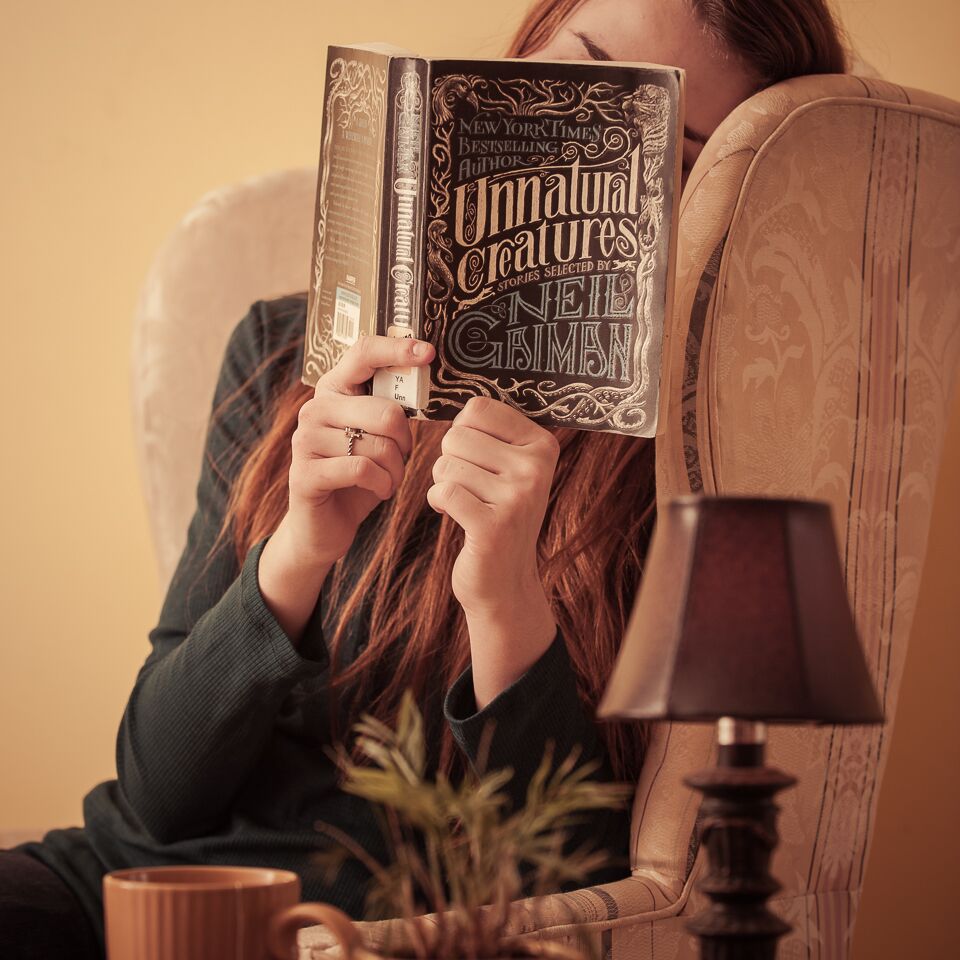
Unnatural Creaures

Unnatural Creatures is a fantastical collection of outrages creatures.
Some were completely bizarre, others were quite amusing; and then there were the ones that were utterly frightening...

This book features sixteen short stories selected by master storyteller Neil Gaiman. 

Reading this book felt like wandering through a museum of myths, from one story into another. Some of these stories were marvelously outlandish. Some made me laugh, others frightened me. 

I loved Gahan Wilson's terrifying creature with the unpronounceable name. I can honestly say I have never read anything quite so peculiar (although I have read a lot of peculiar things.)

Neil Gaiman's own "Sunbird" was undoubtedly one of the highlights of this collection, although I believe the real unnatural creature of this story was Zebediah T. Crawcrustle, (You'll see why.) 

Samuel R. Delany's "Prismatic" was mystifying and really rather fascinating. A haunting story that feels like an old fairy tale.
I loved that the Princess in the story was named after me ;)
"I am a woman worthy of a Prince, and my name is Lea."

But, I think my favorite of all of these was the final story of the collection, which was Peter S. Beagles "Come Lady Death," in which the Lady Death is invited to a dance.
This tale was so bewitchingly enticing. If you ever want to meet the personification of death, and maybe share a dance or two with her, I highly recommend this story.

But, although this library of the unnatural is simply crawling with erratic creatures of all sort, there were a few that disappointed. 

I did not like "The Smile on the Face" one bit. Although the idea seemed promising, the story was very poorly written and the main character was extremely irritating. The setting was ridiculously cliche and the descriptions were altogether pointless. If I wanted to read about a shallow teenage girl I wouldn't be reading in this genre. 

I also didn't enjoy "The Manticore, the Mermaid and Me." Although I thought the idea seemed promising, it was very vaguely written and not at all gripping. 

In the end, I still really enjoyed this book. I love Neil Gaiman, and being able to read some of the stories that he loves gave me a new insight into his imagination, which I so adore. 

Photo credit, like always, goes to Heinrich Nikel Photography! Check out more of his stunning work here.