Showing posts with label Book Reviews. Show all posts

Sunday, August 9, 2020

The Tragedy of Peter Pan

The Star-Crossed Story of How Peter Lost Wendy


I recently wrote about the puzzling feeling of panic my first encounter with Fantastic Mr. Fox left me with. Yet recently I have been thinking about another beloved story from my childhood that leaves me with a far deeper and more personal sort of pain.

The people who are closest to me know that I only watch the film adaptation of J.M. Barrie's Peter Pan (2003) when I'm incredibly sad. This is because as far back as I can remember, watching the film has left me with a deep feeling of heartache that I could never quite explain.


While the book is in some ways lighter and more whimsical than the film I am referring to, it has a similar sense of sorrow beneath its childish fancy that no child will ever fully pick up on. For one, the fairies and pirates are too distracting, but for another, these gentle sorrows are whispered in a voice only an adult will hear. Children need not trouble themselves with them. Peter Pan has other secrets for them. 

Peter Pan is, after all, a tale that is greatly concerned with children and the act of growing up, and naturally, it contains secrets for both adults and children alike.
Like many books, it begins by stating a universal fact (which it will inevitably try to slip away from).
"All children grow up," the book claims.

Yet contained in this very same line the story simultaneously creates an exception.
"Except one," it whispers. And with that Peter Pan slips away across the page, like across the night sky, revealing himself to be the extraordinary exception to the first universal rule every child eventually comes to know.

Childhood feels like it's forever, while it lasts that is. And at the beginning of Barrie's pondering over this simple idea, he informs us that Wendy was aware of the inevitable-ness of her having to age out of childhood ever since she was two years old. It happened when her mother cried out, quite innocently, "oh, why can't you remain like this forever". And there is that word: forever.
"Two is the beginning of the end," Barrie writes. Another fact.

So, Wendy became aware that forever was only a dream; that forever was available to no one, and nothing.

Not even Peter Pan.

 
Growing up is gradual, and you won't know exactly when you've done it, nor will you know how; much less why. I surely can't tell you how it happens, only that it starts happening when a child first begins to mourn that they will not stay this way forever. (I remember crying over this myself when I was young and wanted everything to be permanent.)

Yet Peter Pan remains the grand exception. For Peter, everything is permanent. And so, from the moment she first meets him in her wakefulness, Wendy, who is by now a great deal more grown up than Peter is, knows that she is "in the presence of a tragedy".

Why? Why this painful word at the beginning of a tale about wonder and childishness?
For Peter Pan, there is another word, equally painful; a word out of which all the great tragedies are made. Love.

The first time the tale mentions it we pay it little heed, for it is a grown up word, unfamiliar to the cares of children.
 
The tale tells the account of how Mr. Darling won their mother's heart by stating a very remarkable and seemingly impossible fact: that once upon a time, when her parents were younger, a great "many gentlemen who had (once) been boys when she was a girl discovered simultaneously that they loved her".

Strange, and though perhaps slightly exaggerated, not that strange, after all. For that is how it works. Is it not? One moment you are two and just beginning to wonder if things will ever change, and the next, there is first love; a love that by its first-ness is so unlike the simple love you once knew for your parents. It is not even like the love you have seen your parents display for one another, for there is nothing practical nor sensible about it. This love is a truly unique sort of love, totally untarnished by adulthood. And it is likely that you will never feel anything like it again.
That is part of the enchantment: that you can only love in this way while you are a child, and no child can ever love this way more than once.


It is exactly this type of love that, I believe, Peter Pan feels for Wendy, and she in turn feels for him. It is a love rich in childishness.
We do not know when Peter first sees her. But we do know that she is the first girl he ever brings to Neverland, and I believe that speaks for itself.

As Wendy and her brothers fly away, the narrator asks us if the parents will reach the nursery in time. But time is of little relevance in this story– at least, for now, and if time had played its course then and worked its right, then we would have no story at all.
Yet, when the narrator solemnly promises us that "it will come right in the end" one could also suppose that he not talking about the parent's distress at finding the nursery empty. What he might just as well be saying is that the children will not slip out of time forever. Either way, the answer is the same: the children will return, and time will go right before the story ends.

 
After this, great adventures are had in Neverland, and though it would bring me great thrill to recount them, I think that would be missing the point. I am no longer a child, after all; and adventure, though wonderful, does not apply nor speak to me as it once did. I think of the coming chapters fondly. But nonetheless, they always end so quickly. I cannot hold onto them no matter what I do. The pages pass too quickly. 

But glimpsed between these lines, we see the tragic nature of Peter, and this has never left me.  Wendy knew from the beginning that she was in the presence of a tragedy, and she sees it also there, in the wondrous Neverland. She sees it late at night, when Peter Pan is sleeping and unaware of her.

The narrator tells us that sometimes Peter had dreams that are fully unlike the dreams of other boys, for they were more painful and far more troubling.

"For hours he could not be separated from these dreams, though he wailed piteously in them... At such times it has been Wendy's custom to take him out of bed and sit with him on her lap, soothing him in dear ways of her own invention, and when he grew calmer to put him back to bed before he woke up, so that he should not know of the indignity to which she has subjected him."

The narrator never tells us what Peter Pan was dreaming about, only that these dreams had to do with the riddle of Peter's existence. Yet their very painfulness reveals to me now a piece of the tragedy. No feeling, no matter how unchildlike, can alter Peter's nature, can push him into adulthood. Children grow up gradually; they grow up every time they feel something that their childish hearts cannot bare, beginning with the very feeling of the impermanence of the things around them, or of themselves. It lies in the painful contradiction of Peter's nature that a boy who dreams of such un-boyish and troublesome things cannot grow up, can neither out grow them or grow up to understand them better.

Peter Pan has another dream the night they fly back to London to bring Wendy and her brothers home. The story tells us that Wendy held him tight that night, while he was sleeping. But the chapter ends there, and in the one that follows, Wendy Darling returns home. And so, Peter Pan is confronted with the first thing since his whimsical life on Neverland began that has not been permanent.

Peter Pan never admits to loving Wendy, as boys that age never do, expect maybe to their mothers. Peter Pan does. And, because everyone knows that Peter Pan does not have a mother, he tells her's (though she's asleep, and so, she does not hear him.) "I'm fond of her too," he whispers.

 
As the children reunite with their parents, the narrator takes us back outside the window to glance at the sight of the "strange boy", a boy who he tells us as "ecstasies innumerable that other children can never know". And yet, here he was "looking at the one joy from which he must be forever barred."

For Peter Pan, the space between growing up is as narrow and thin as the sheet of glass from Wendy Darling's nursery window.

So why all this? Well, it dawned on me when I listened to Taylor Swifts new song "Cardigan", of all places. Therein lies a line that brought be back to this familiar heart ache story, a line about how Peter loses Wendy.

Strange, that Taylor Swift should sing about Peter Pan in a break up song; and yet, not so strange at all. Because Peter Pan does lose Wendy, in the end. But that is not what makes it all so terrible. What really hurts deep within myself, is the part of me that knows that it takes growing up to get over such a heart break.


The story of Peter Pan, with all its marvelousness and magic, still makes me ache. It made me ache as a child, but only because I could sense, even then, how terribly lonely Peter Pan was there at the end of the film when he looks at Wendy through the window.
As I grew, it reminded me of a different kind of heart ache, the kind that breaks your heart when a childish love doesn't end well and it feels like all the world will never be the same.
I cannot even listen to the musical piece from the film entitled "Fairy Dance" without feeling a twinge of loss deep inside myself, in a box that no one else will ever open. Over time though, I have learned that it is a beautiful kind of heart ache. The kind of hurt your heart feels when you love someone so much that it aches inside, like a tight hug in reverse.

At last, a few weeks ago, I walked down the aisle to this song, so forever reversing what was once a tragedy into the fairy tale definition of a happy ending.

The only feeling of sadness I feel now is that I might never need to watch Peter Pan again; that there will never be a night in which my heart hurts so much that it feels like the world is ending. I have grown out of it, I suppose.

Now, when I hurt, I get to hug my husband. And, what's more, I know from experience that time will pass, and I will grow in wisdom, and I one day I will get over it, no matter how deep the hurt. 


Friday, July 17, 2020

Willy Wonka's Whammy

How Wonka's Wonka-Vite Exposed Granny's Greed

"Mr. Wonka shook his head sadly and passed a hand over his eyes. Had you been standing very close to him you would have heard him murmuring softly under his breath, 'Oh, deary deary me, here we go again...'" ~Charlie and the Great Glass Elevator


It is no great secret that Charlie Bucket was the most well behaved of the group of otherwise snotty children that visited Willy Wonka's marvelous Chocolate Factory. Compared to the gluttonous Augustus Gloop, the pretentious Violet Beauregarde, conceited Veruca Salt, and finally, Mike Teavee the television fiend, Charlie Bucket is an angel. The second the children and their chaperones step into the factory and the great doors close behind them, the reader is already certain that Charlie will come out on top.
But, as the other four children fall one by one into the horrid temptation of their greed, we realize that not all of them will come out entirely as they were. Whether the fate of these children horrifies, perplexes, or disturbs you, I very much doubt that their behavior did not, at the very least, exhaust you. For what exhausting children they are; how ill-behaved, how spoiled, and how awfully greedy.

Augustus Gloop, for example, is compared to a pig. When we are first introduced to him he is described to have

"great flabby folds of fat bulg(ing) out from every part of his body"

and a face like

"a monstrous ball of dough with two small greedy curranty eyes peering out upon the world" 

One might say that these horrid children got what they had coming for them, that their punishment serves them right. But they are only children, after all. Yet the book assures us that the alarming experiences they undergo while in the factory do not change them for the better. 

The Oompa Loompa's claim that

"however long (the) pig (aka Augustus Gloop) might live,
we're positive he'd never give
even the smallest bit of fun or happiness to anyone". 

A truly horrifying thing to say about a child. But even so, one is inclined to believe them. For Augustus Gloop, like the others, is, to put it shortly, an obnoxious child with little to redeem him beyond his youngness. If anything can, his inexperience may excuse his behavior.
One cannot say the same for the adults.

Upon reading the second tale of Charlie Bucket's adventures with the extraordinary Willy Wonka, I was surprised to be confronted with similar behavior, though this time its perpetrators were not four foolish children, but four foolish adults.

While Roald Dahl's stories feature many charming children much like Charlie, his adult characters are not nearly so pleasant. In fact, many are horrid, evil, and nefarious.

None of these things can be said about the kindhearted parents of Charlie Bucket, and indeed, there hardly ever was a sweeter set of grandparents than Charlie's. Till Grandma Georgina became the worst of the lot, that is.

If you don't believe me, simply read the chapter entitled "Good-Bye Georgina" in Roald Dahl's Charlie and the Great Glass Elevator in which Grandma Georgina undergoes the most drastic transformation brought upon by greed. In this chapter, Willy Wonka reveals that his candy is capable of anything. It is, in fact, so marvelous that his Wonka-Vite, a candy which he claims is basically the "most valuable bottle of pills in the world", can actually make somebody younger. Each pill, Wonka explains, shaves exactly 20 years off your age.

The pills immediately bring out the worst in the four elderly folk. And despite Wonka's precautions, too many pills are swallowed. The cries of wonder quickly turn to screams as the grandparents won't stop aging backwards. Their age falls off them so far and so fast that they are reduced to helpless, quibbling babies. And she with the worst behavior, she who swallowed the pills most greedily, is reduced to nothing at all. Grandma Georgina swallowed a few pills too many, and aged backwards, right out of existence. 

In a way, it is not so much the shock of these harsh and drastic punishments that alarms us. Adults meet far more violent ends in other tales by Roald Dahl. When James' aunts get crushed by his giant peach, for example, it is not just the gruesome end that disturbs us, but that this end was actually deserved. Indeed, no children's story has ever dealt in catharsis, debasing human characters into caricatures of greed, cruelty, and depravity to the point that they actually deserve be indefinitely punished, even to die.

Dahl's un-corrupted children (usually the protagonist) are contrasted with these cruel adults and snotty youngsters, who are often comparable to animals, or worse, to monsters. Indeed, anyone who has had the misfortune of running from the tyrannical beast of a woman Miss Trunchbull or been stuck in a room full of bald children-eating witches cannot doubt that Dahl's stories are much more sinister than the average children's story. Yet these characters nonetheless resemble real adult and childish foolishry, exaggerated both by the perspective of a child and the scope of fiction.


Whatever else can be said about the adventures of Charlie Bucket, it becomes clear when Grandma Georgina disappears in the pit of her own greed that Willy Wonka has a harmatia of his own, a fatal mistake, a whammy, if you will, that corrupts those around him and curses his otherwise extraordinary existence. 

The golden ticket in Charlie and the Chocolate Factory that invites the five children to Wonka's factory promises them

"mystic and marvellous surprises that will entrance, delight, intrigue, astonish, and perplex beyond measure".

But it is no coincidence that four out of five children that visit the factory fall into the inevitable down fall brought on by their greed. Two out of four adults offered the chance to age backwards are reduced back to blubbering children, while another is eaten up completely. And, if Wonka's marvelous invention can bring out the worst in even the sweet grandparents of Charlie Bucket, well, it becomes all to clear why Willy Wonka shut himself up in his factory in the first place.

Monday, June 1, 2020

Who Killed Sherlock Holmes?

 An Analysis of the Prime Example of Fictional Immortality 

Sherlock Holmes is perhaps the most recognizable fictional character of all time, something which is somewhat remarkable considering how many faces he’s worn. It seems strangely suitable that Sherlock Holmes, among his many skills, should also be a master of disguise. For each time he returns, be it to the stage, the screen, or on the page, he is never quite the same. In all the different faces which have represented Sherlock Holmes we have come to recognize him mainly by his distinguished silhouette: the large beak-like nose, the tall lean figure, the deer-stalker hat, and calabash pipe, all of which are signature to his demeanor. Yet ironically, most of these are credited, not to Conan Doyle himself, but to British illustrator Sidney Paget. Even Holmes' well-known catchphrase “Elementary, my dear Watson” comes, not from the original work, but from author P.G. Wodehouse. These are not the only well-known Holmesian characteristics which are credited to other creators. Ever since Conan Doyle let loose detective Sherlock Holmes into Victorian London in A Study in Scarlet, artists have been creating their own interpretations of the world-famous detective, and thus he has become immortalized, not just by one, but thousands of reworkings and adaptations. It may therefore seem somewhat misleading to fully credit Arthur Conan Doyle with the creation of Sherlock Holmes. Perhaps it is more suitable to say rather that Conan Doyle did not in-fact create Holmes. He discovered him.

Though it may seem an odd statement, it seems that Sherlock Holmes is, in fact, more influential than the man who created him. This in itself is entirely bizarre, for Holmes, of course, is fictional. Yet even in his time, multitudes of readers were convinced of his existence. To Doyle's own dismay, he received countless letters all address not to him, but to Sherlock, imploring the detective to help solve their tragedies and mysteries. In the present day, Sherlock Holmes seems more alive and real than Conan Doyle himself. So, Holmes has become the reality and the author the shadow, a silhouette perched in an armchair behind the figure of his creation. Though the simple solution would be to dismiss this as a case of excellent story-telling, someone like Sherlock Holmes would not be convinced of such a mundane conclusion.

It deems worth noting that Sherlock Holmes is not the only fictional character granted this endowment of immortality, nor is he the only one who has skipped the line between reality and fiction so effortlessly. Figures like King Arthur or Robin Hood of Loxley, to name a few, have also crossed this line, slipping out of the fictional world and leaving behind relics and remnants of misplaced evidence, as if they might actually have existed. Indeed, to this day experts are still uncertain whether or not these figures actually existed, and to what extent the stories we have about them are true. While their origins may be obscure, their influence, however, is undeniable. Sherlock Holmes himself does not have much in common with these figures, it is their mutual prestige on the public which makes them so extraordinary. Of course, there is one other key point in which these figures share: they are all heroes.
King Arthur, the righteous and just king, leader of the Knights of the Round Table, Robin Hood, the noble outlaw who steals from the rich and gives to the poor, we’ve all heard of them. But what exactly does Sherlock Holmes have to do with them?

When we think of Detective Sherlock Holmes, words like righteous, just, and noble are certainly not the first that come to mind, if, in fact, they come to mind at all. Sherlock Holmes is flawed, often times selfish, and at times completely unsympathetic. Indeed, he has been compared to machine. What's more, it is his lack of human weakness and emotion that most fascinates those fictional characters who come know him, and those who in their turn come to know him on the page. Even so, when it comes to fictional immortality Holmes somehow manages to exceed them all. While King Arthur and Robin Hood were the heroic figures of their own time, Sherlock Holmes has become a heroic icon, not only of his own time but most every time since.

When a character becomes immortalized in this way they will inevitably become, not just a character, but an idea. Robin Hood, for example, exemplifies justice. He is a hope for the poor, a reclamation of a better world in a time of oppression. In the same way, Sherlock Holmes has also become the incarnation. He is the image of the ultimate expert. A man who, with his powers of deduction and wit can unravel any mystery. Sherlock Holmes springs out of an era of order, an industrious empire, a society overtaken with invention and vision, and yet a society overcome by the ever-growing fear that their world, a world of which the pace was ever quickening, was spinning out of control. This is a fear which is no less relevant in today’s society than it was to the Victorians who witnessed the First Industrial Evolution when the world began to move too quickly. One could argue that the world has not stopped its Industrial ascent since.

It is perhaps for this very reason that, more than a decade after his initial appearance, Sherlock Holmes has still not retired, despite what Doyle tried to make us believe in The Adventure of the Lion's Mane. And if he has indeed retired at one point or another, he has been raptly replaced by a successor, a new Sherlock Holmes for a new time.
Since Conan Doyle’s death in 1930, the public has seen Sherlock Holmes return again and again. Indeed, ever since Arthur Conan Doyle brought back Sherlock Holmes ten years after his supposed death, it seems it is quite impossible to kill him. His immortality is so adamant, and the public’s adoration so persistent, that not even his creator could kill him off. We see in Sherlock Holmes that something truly fascinating occurs when a character outlives his creator with such perpetuation. Not only has Sherlock Holmes outlasted his time, he has pervaded through every time since, slinking straight out of the fog of Victorian London into the present day, solving mysterious and delivering justice, whether that be to protect innocent murderers, or the wrongfully accused; to restore honor to the disgraced or repair trust for those that have been torn apart by a crippled system. He is a shadow of a man instantly recognized by his fans, fans who as a mass manage to maintain the illusion that Mr. Sherlock Holmes, the detective who has, and most certainly will, outlive them all, is still out there today, solving mysteries, dispelling superstitions, disproving irrationality and illusion; debunking legends even as he himself becomes one.


Sunday, April 30, 2017

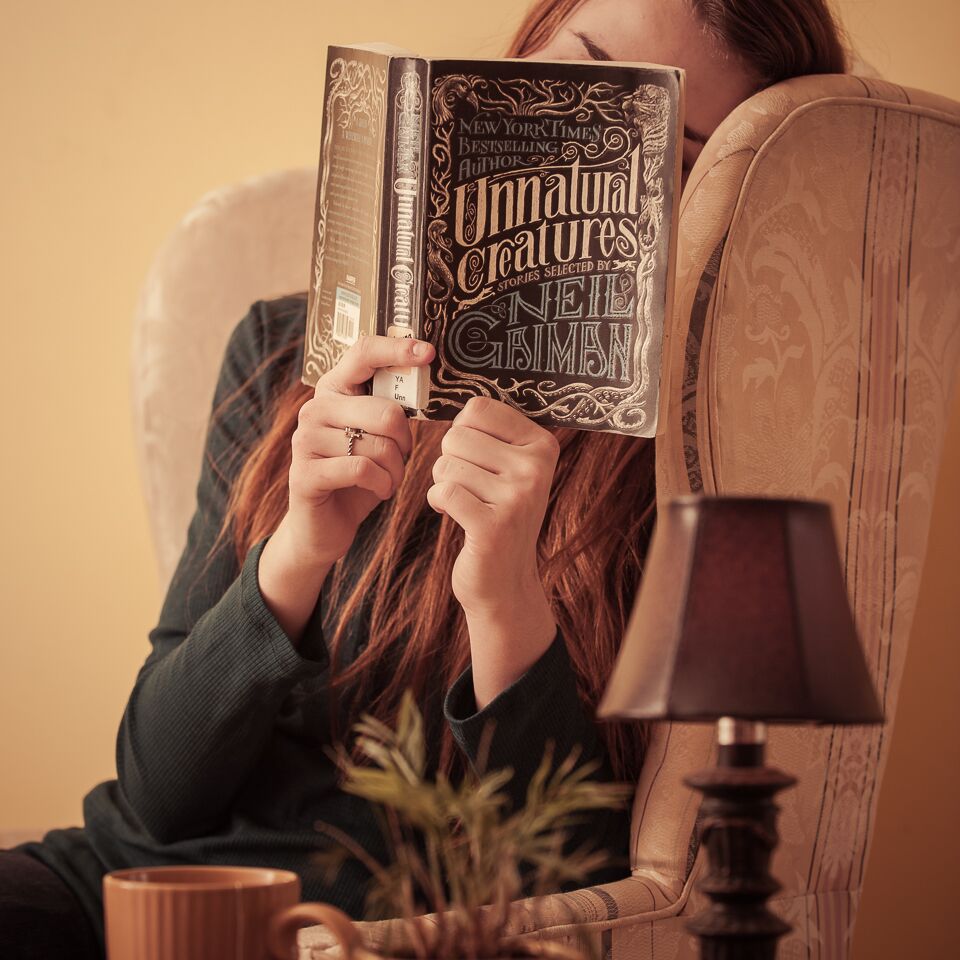
Unnatural Creaures

Unnatural Creatures is a fantastical collection of outrages creatures.
Some were completely bizarre, others were quite amusing; and then there were the ones that were utterly frightening...

This book features sixteen short stories selected by master storyteller Neil Gaiman. 

Reading this book felt like wandering through a museum of myths, from one story into another. Some of these stories were marvelously outlandish. Some made me laugh, others frightened me. 

I loved Gahan Wilson's terrifying creature with the unpronounceable name. I can honestly say I have never read anything quite so peculiar (although I have read a lot of peculiar things.)

Neil Gaiman's own "Sunbird" was undoubtedly one of the highlights of this collection, although I believe the real unnatural creature of this story was Zebediah T. Crawcrustle, (You'll see why.) 

Samuel R. Delany's "Prismatic" was mystifying and really rather fascinating. A haunting story that feels like an old fairy tale.
I loved that the Princess in the story was named after me ;)
"I am a woman worthy of a Prince, and my name is Lea."

But, I think my favorite of all of these was the final story of the collection, which was Peter S. Beagles "Come Lady Death," in which the Lady Death is invited to a dance.
This tale was so bewitchingly enticing. If you ever want to meet the personification of death, and maybe share a dance or two with her, I highly recommend this story.

But, although this library of the unnatural is simply crawling with erratic creatures of all sort, there were a few that disappointed. 

I did not like "The Smile on the Face" one bit. Although the idea seemed promising, the story was very poorly written and the main character was extremely irritating. The setting was ridiculously cliche and the descriptions were altogether pointless. If I wanted to read about a shallow teenage girl I wouldn't be reading in this genre. 

I also didn't enjoy "The Manticore, the Mermaid and Me." Although I thought the idea seemed promising, it was very vaguely written and not at all gripping. 

In the end, I still really enjoyed this book. I love Neil Gaiman, and being able to read some of the stories that he loves gave me a new insight into his imagination, which I so adore. 

Photo credit, like always, goes to Heinrich Nikel Photography! Check out more of his stunning work here.